Encyclopaedia Judaica
Jews in Morocco 06: Alawid rule coming against the Jews
Tetuán loan affair and massacres 1790-1792 - restrictions and ghettos under Mulay Suleiman - epidemics and emigration movement 1799 and 1818
from: Morocco; In: Encyclopaedia Judaica 1971, vol. 12
presented by Michael Palomino (2008)


| Share: |
Facebook |
|
Twitter
|
[Bloodthirsty sultan son Mulay al-Yazid:
Tetuán loan affair with sultan son Mulay al-Yazid escalates in a prosecution of all Jews in 1790-1792: Tetuán plundered - Jews hanged - Muslims hide many Jews from the prosecution - Jews in Marrakesh massacred and taken into captivity - also Muslims massacred]
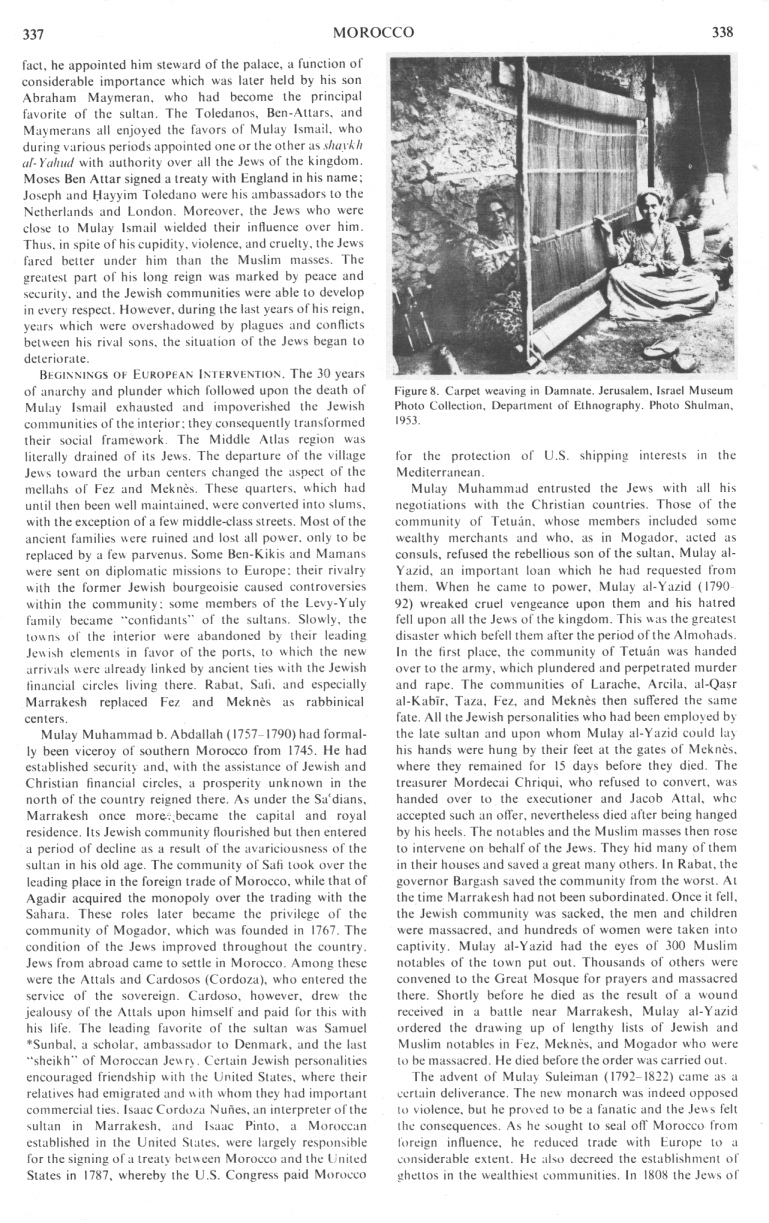
Those of the community of Tetuán, whose members included some wealthy merchants and who, as in Mogador, acted as consuls, refused the rebellious son of the sultan, Mulay al-Yazid, an important loan which he had requested from them. When he came to power, Mulay al-Yazid (1790-92) wreaked cruel vengeance upon them and his hatred fell upon all the Jews of the kingdom. This was the greatest disaster which befell them after the period of the Almohads.
In the first place, the community of Tetuán was handed over to the army, which plundered and perpetrated murder and rape. The communities of Larache, Arcila, al-Qasr al-Kabir, Taza, Fez, and Meknès then suffered the same fate. All the Jewish personalities who had been employed by the late sultan and upon whom Mulay al-Yazid could lay his hands were hung by their feet at the gates of Meknès where they remained for 15 days before they died. The treasurer Mordecai Chriqui, who refused to convert, was handed over to the executioner and Jacob Attal, who accepted such an offer, nevertheless died after being hanged by his heels.
The notables and the Muslim masses then rose to intervene on behalf of the Jews. They hid many of them in their houses and saved a great many others. In Rabat, the governor Bargash saved the community from the worst.
At the time Marrakesh had not been subordinated. Once it fell, the Jewish community was sacked, the men and children were massacred, and hundreds of women were taken into captivity.
Mulay al-Yazid had the eyes of 300 Muslim notables of the town put out. Thousands of others were convened to the Great Mosque for prayers and massacred there.
Shortly before he died as the result of a wound received in a battle near Marrakesh, Mulay al-Yazid ordered the drawing up of lengthy lists of Jewish and Muslim notables in Fez, Meknès, and Mogador who were to be massacred. He died before the order was carried out.
[Prosecution of the Jews under sultan Mulay Suleiman: Restrictions of trade with Europe - ghettos for Jews]
The advent of Mulay Suleiman (1792-1822) came as a certain deliverance. The new monarch was indeed opposed to violence, but he proved to be a fanatic and the Jews felt the consequences. As he sought to seal off Morocco from foreign influence, he reduced trade with Europe to a considerable extent. He also decreed the establishment of ghettos in the wealthiest communities. In 1808 the Jews of (col. 338)
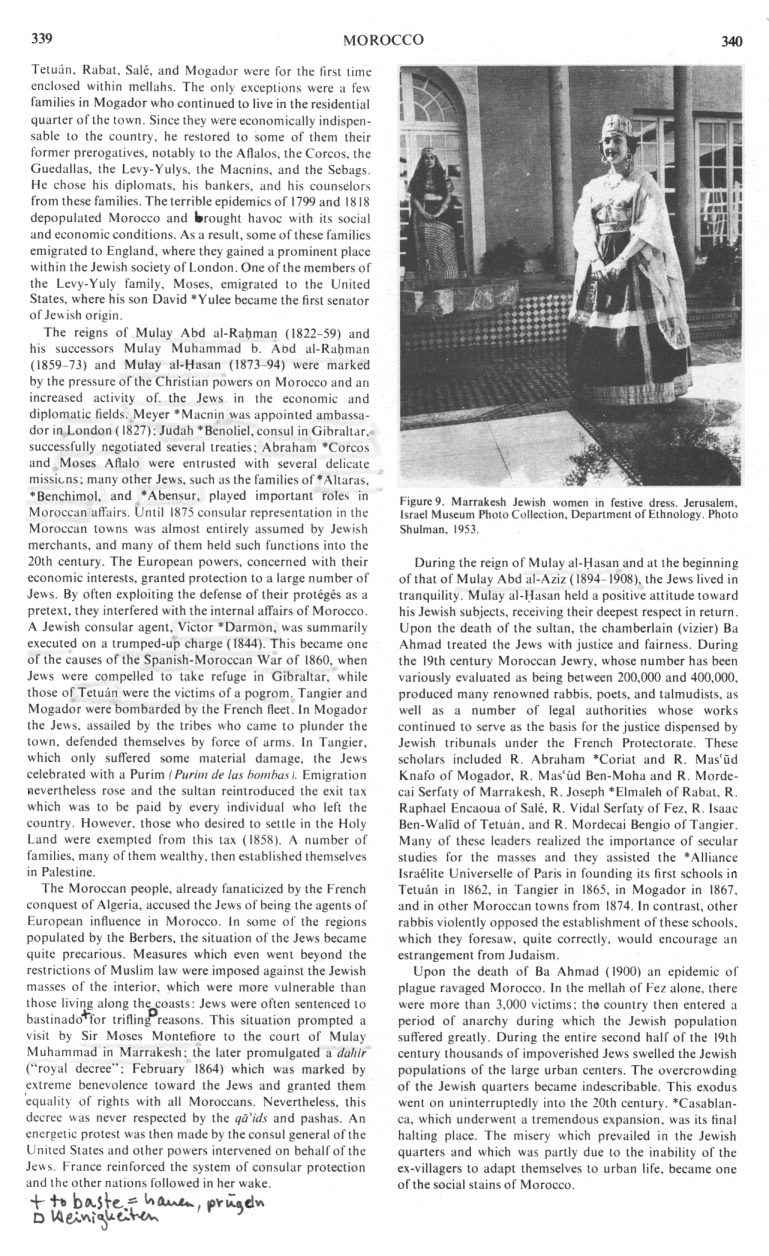
Tetuán, Rabat, Salé, and Mogador were for the first time enclosed within mellahs. The only exceptions were a few families in Mogador who continued to live in the residential quarter of the town. Since they were economically indispensable to the country, he restored to some of them their former prerogatives, notably to the Aflalos, the Corcos, the Guedallas, the Levy-Yulys, the Macnins, and the Sebags. He chose his diplomats, his bankers, and his counselors from these families.
[Epidemics of 1799 and 1818 - population reduction and emigration movement]
The terrible epidemics of 1799 and 1818 depopulated Morocco and brought havoc with its social and economic conditions. As a result, some of these families emigrated to England, where they gained a prominent place within the Jewish society of London. One of the members of the Levy-Yuly family, Moses, emigrated to the United States, where his son David *Yulee became the first senator of Jewish origin.> (col. 339)
Sources
Encyclopaedia Judaica 1971: Morocco, vol. 12, col. 337-338
Encyclopaedia Judaica 1971: Morocco, vol. 12, col. 339-340
Encyclopaedia Judaica 1971: Morocco, vol. 12, col. 341-342
Encyclopaedia Judaica 1971: Morocco, vol. 12, col. 343-344