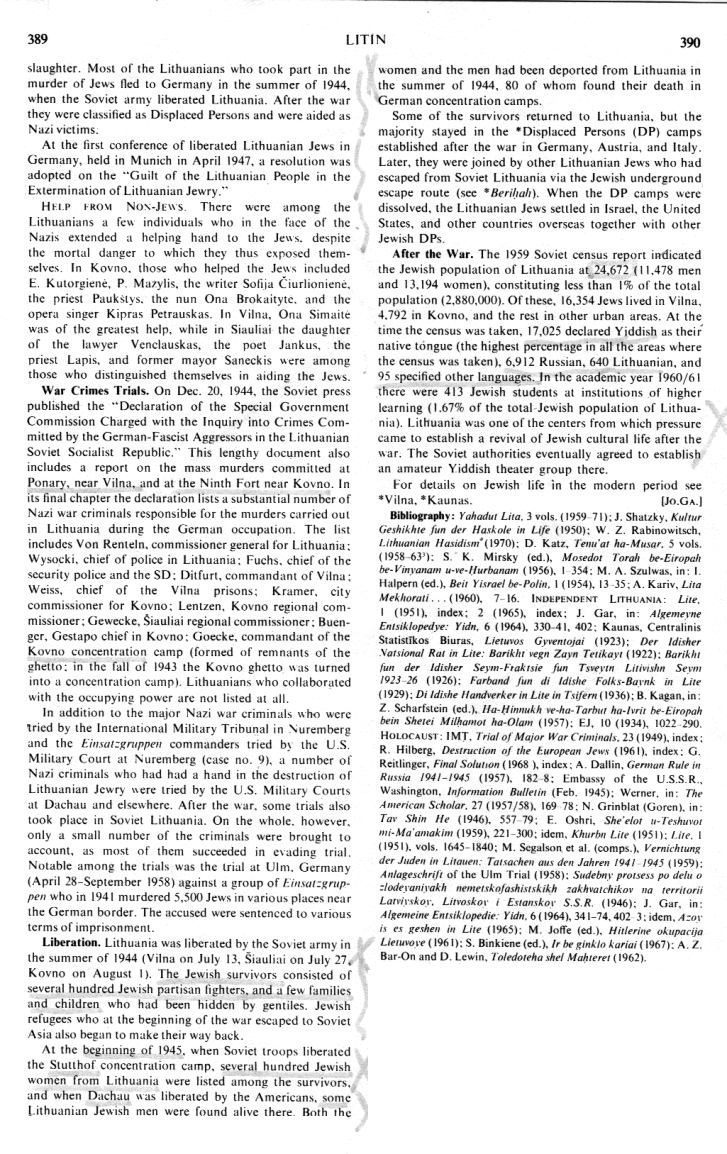
<Liberation [communist
occupation of 1944]
Lithuania was liberated [[occupied]] by the Soviet army in
the summer of 1944 (Vilna on July 13, Siauliai (©iauliai)
on July 27, Kovno on August 1). The Jewish survivors
consisted of several hundred Jewish partisan fighters, and
a few families and children who had been hidden by
gentiles. Jewish refugees who at the beginning of the war
escaped to Soviet Asia also began to make their way back.
(col. 389)
[[The communist Gulag system is never mentioned in the
Encyclopaedia Judaica]].
[1944-1947:
Lithuanian Nazis flying to Germany]
Most of the Lithuanians who took part in the murder of
Jews fled to Germany in 1944, when the Soviet army
liberated Lithuania [[and occupied Lithuania with another
sovietization]]. After the war they [[the Lithuanian Nazis
in Germany]] were classified as Displaced Persons and were
aided as Nazi victims. (col. 389)
[[At that time this was easy to perform with forged
passports, changed names or with the indication to be a
Jew...]]
At the beginning of 1945, when Soviet troops liberated
[[occupied]] the Stutthof concentration camp, several
hundred Jewish women from Lithuania were listed among the
survivors, and when Dachau was liberated by the Americans,
some Lithuanian Jewish men were found alive there. Both
the (col. 389)
women and the men had been deported from Lithuania in the
summer of 1944, 80 of whom found their death in German
concentration camps.
Some of the survivors returned to Lithuania, but the
majority stayed in the *Displaced Persons (DP) camps
established after the war in Germany, Austria, and Italy.
Later, they were joined by other Lithuanian Jews who had
escaped from Soviet Lithuania via the Jewish underground
escape route (see *Berihah
(Beriḥah)). (col. 390)
At the first conference of liberated Lithuanian Jews in
Germany, held in Munich in April 1947, a resolution was
adopted on the "Guilt of the Lithuanian People in the
Extermination of Lithuanian Jewry". (col. 389)
When the DP camps were dissolved, the Lithuanian Jews
settled in Israel, the United States, and other countries
overseas together with other Jewish DPs. (col. 390)
War
Crimes Trials.
[[The Lithuanian Nazis who had fled to Germany, who had
disguised themselves as Jews and had been treated as DPs
could evade the war crimes trials but are chased until
today by the Jewish organizations]].
On Dec. 20, 1944, the Soviet press published the
"Declaration of the Special Government Commission Charged
with the Inquiry into Crimes Committed by the
German-Fascist Aggressors in the Lithuanian Soviet
Socialist Republic". This lengthy document also includes a
report on the mass murders committed at Ponary, near
Vilna, and at the Ninth Fort near Kovno. In its final
chapter the declaration lists a substantial number of Nazi
war criminals responsible for the murders carried out in
Lithuania during the German occupation. The list includes
-- Von Renteln, commissioner general for Lithuania
-- Wysocki, chief of the Vilna prison
-- Kramer, city commissioner for Kovno
-- Lentzen, Kovno regional commissioner
-- Gewecke, Siauliai (©iauliai) regional commissioner
-- Buenger, Gestapo chief in Kovno
-- Goecke, commandant of the Kovno concentration camp
(formed of remnants of the ghetto; in the fall of 1943 the
Kovno ghetto was turned into a concentration camp).
Lithuanians who collaborated with the occupying power are
not listed at all.
[[The communist Stalin regime needed the remnants of the
population for their regime]].
In addition to the major Nazi war criminals who were tried
by the International Military Tribunal in Nuremberg and
the Einsatzgruppen
commanders tried by the U.S. Military Court at Nuremberg
(case no. 9), a number of Nazi criminals who had had a
hand in the destruction of Lithuanian Jewry were tried by
the U.S. Military Courts at Dachau and elsewhere. After
the war, some trials also took place in Soviet Lithuania.
On the whole, however, only a small number of the
criminals were brought to account, as most of them
succeeded in evading trial. Notable among the trials was
the trial at Ulm, Germany (April 28-September 1958)
against a group of Einsatzgruppen
who in 1941 murdered 5,500 Jews in various places near the
German border. The accused were sentenced to various terms
of imprisonment. (col. 389)
After
the War. [Jews in communist Lithuania according to the
counting of 1959]
[[The huge anti-Semitic propaganda waves since the
founding of the racist Free Mason Zionist CIA state of
Israel are not mentioned. Also the discrimination of Jews
in the professions is not mentioned in the article. It can
be admitted that only about 30% of the Jews of 1947 and
their children indicated to be Jewish in the counting of
1959. The article is hiding these facts pretending the low
number of Jews of 1959 would be the result of the
Holocaust only]].
The 1959 Soviet census report indicated the Jewish
population of Lithuania at 24,672 (11,478 men and 13,194
women), constituting less than 1% of the total population
(2,880,000). Of these, 16,354 Jews lived in Vilna. 4,792
in Kovno, and the rest in other urban areas. At the time
the census was taken, 17,025 declared Yiddish as their
native tongue (the highest percentage in all the areas
where the census was taken), 6,912 Russian, 640
Lithuanian, and 95 specified other languages. In the
academic year 1960/61 there were 413 Jewish students at
institutions of higher learning (1.67% of the total Jewish
population of Lithuania). Lithuania was one of the centers
from which pressure came to establish a revival of Jewish
cultural life after the war. The Soviet authorities
eventually agreed to establish an amateur Yiddish theater
group there.
For details on Jewish life in the modern period see
*Vilna, *Kaunas.
[JO. GA.]