Encyclopaedia Judaica
Jews in Cracow 04: nationalism and anti-Semitism
Assimilationists - Hebrew nationalism - Polish and German nationalism - Cracow during anti-Semitic Poland 1919-1939
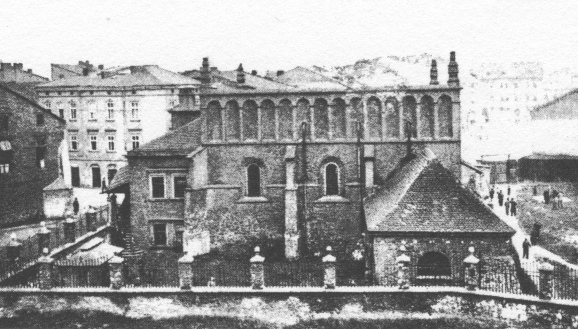
Encyclopaedia Judaica (1971): Cracow, vol. 5, col. 1033. The medieval synagogue in Cracow.
From a postcard of the mid-1930s. Cecil Roth Photo Collection.
from: Cracow; In: Encyclopaedia Judaica 1971, vol. 5
presented by Michael Palomino (2008 / 2020)
Share:
<The Period of National Awakening. [Enlightenment Jews in the Jewish Religious Council - Jewish students]
After the grant of emancipation in 1867 / 68 to the Jews of Cracow, which carried with it the unrestricted right of settlement in Cracow itself, the community institutions were abolished and a Jewish Religious Council established in which the assimilationist maskilim [[followers of the Haskalah, enlightenment Jews, secularists]] and intelligentsia replaced the oligarchic leadership.
In 1870, Simon Samuelsohn became chairman of the council. In 1869 there were 25 Jewish students (13% of the total) studying at the law faculty of the university, 14 (7%) at the faculty of medicine, and 10 at the technical college. During the early 1870s, about 200 Jewish pupils attended secondary schools and teachers' training colleges in Cracow.
[Hebrew nationalism and installation of Hebrew institutions]
The first secular Hebrew public library in Cracow was founded in 1876. The The first Hebrew school in the town, headed by the av bet din [[eldest court chairman]] Hayyim (Ḥayyim) Aryeh Horowitz, was established by the Shoharei (Shoḥarei) Tov ve-Tushiyyah Society in 1874. A branch of the *Alliance Israélite Universelle was established at Cracow in 1867. In 1876 a talmud torah [[school]] was founded and remained open until 1881. Later a school for the teaching of crafts was established by the *Baron de (col. 1034)
Hirsch Fund, as well as a vocational school financed by Arnold Rapaport, a member of the Austrian parliament.
[[The main fault that to be Jewish is a religion and not a nation is not mentioned in Encyclopaedia Judaica]].
Toward the close of the 19th century, the Jewish educational system of Cracow included hadarim (ḥadarim) [[Jewish religious schools to age of 13]] and yeshivot [[religious Torah schools]] (see also *Mahzike Hadas), as well as elementary and secondary schools with Polish and German as the languages of instruction.
[Professions - careers - numbers]
While hasidic (ḥasidic) [[Orthodox]] influence remained strong among the mass of Jews, with the influences of emancipation, *Haskalah [[enlightenment]], and assimilation many Jews became prominent in the Polish-German cultural and social life of Austrian Cracow, among them the professor of philology Leon Sternbach, the painter Maurycy Gottlieb, the jurist Joseph Rosenblatt, and the physicians Philip Eisenberg and Isidor Jurowich, who became director of the Jewish hospital in Cracow (see also *Aguddat Ahim (Aḥim)). Several Jews made fortunes in financial and industrial enterprises, notably Maurycy Datner, who became president of the Chamber of Commerce and Industry of the city.
The Jewish population numbered 25,670 in 1900 (28% of the total), and 32,321 in 1910 (21%). A considerable number (col. 1035)
earned their livelihood in the grocery, haberdashery, leather, textiles, and clothing businesses. IN addition to owning shops or stalls, many were occupied in hawking and the purchase of pig bristle and horsehair in the surrounding villages for industry. The wealthier Jewish merchants, a minority, owned wine and textile warehouses and were mainly engaged in the export of timber, feathers, and eggs. Among the artisans, most numerous were tailors, glaziers, and carpenters. There were 52 Jewish physicians in Cracow (out of the total of 248) and 47 Jewish lawyers (out of 110) in 1900.
[Growing anti-Semitism within nationalism between Poles and Germans - racist Zionism]
*Anti-Semitism grew in Cracow at the close of the 19th century, amid the national rivalries in the city and demands that Jews should identify themselves with the Polish or German elements. At the same time the Jewish national revival began to penetrate to Cracow. The first *Hovevei (Ḥovevei) Zion society, Rosh Pinnah, was established during the 1880s under the leadership of Simeon Sofer and Aaron Markus. During this period, the concepts of Hebrew revival were propagated; from 1892 the Sefat Emet Society and the Hevrah (Ḥevrah) Ivrit le-Tarbut ("Hebrew Society for Culture"), headed by Israel Krasucki, the publisher of the periodical Ha-Maggid he-Hadash (he-Ḥadash) (published in Cracow), Jacob Samuel Fox, and later by the journalist Simeon Menahem Lazar, editor of Ha-Mizpeh (Ha-Miẓpeh), was active there.
From 1897 political Zionism won supporters, among whom Osias *Thon and Julius Schenweter were prominent, and an academic national society, Shahar (Shaḥar) was founded. In 1906, the Jewish Nationalist Group was founded in Cracow. The organ of the Po'alei Zion, Der Yidisher Arbeter [[Yidd.: The Yiddish Worker]], was published in Yiddish in Cracow between 1905 and 1914. In 1900 the Group of Independents fighting for civic equality and the rights of the Jewish population was established, headed by Ignaz *Landau and Adolf *Gross. The Committee of the Delegates of the [[racist]] Zionist Organizations of Western Galicia was established in Cracow under the leadership of Joseph Margolioth in 1905.
[Scholars and writers]
During this period Cracow became an important center of Jewish cultural activity, with the historians Hayyim (Ḥayyim) Nathan *Dembitzer and Feivel Hirsch *Wettstein, scholars such as Shlomo *Rubin, the Hebrew author David Rotblum, and the popular Yiddish poet Mordecai *Gebirtig, who became celebrated in connection with the Holocaust.
[[The important time of the First World War I with it's battlefields, Jewish refugees and hardship is not mentioned in the article]].
After World War I.
[Harsh conditions and harsh Polish anti-Semitism since 1918 in Cracow - riots and Jewish self-defense]
The rise of Polish nationalism and the movements connected with the upheavals of World War I, widespread unemployment, the return of armed soldiers and deserters, and famine throughout the city and vicinity, combined to intensify anti-Semitism. In 1918 the community was threatened with an outbreak of pogroms. The Endeks (*Endecja) elements attempted to direct the discontent of the Polish masses against the Jews. The Jewish youth in Cracow organized *self-defense, led by Jacob Billik and Y. Alster, and were joined by Jewish soldiers who had returned from the front. The entry of the troops of the anti-Semitic Polish General *Haller into Cracow set off a wave of riots which were warded off by the Jewish self-defense groups, who at the end of 1918 and the beginning of 1919 had a number of clashes with the rioters.
[Numbers and professions 1921-1931]
The Jewish population of Cracow numbered 45,229 in 1921, and according to the 1931 census, 56,800 (25.9% of the total), of whom 31% were occupied in industry and crafts (compared with 30% among non-Jews), 46% in commerce and insurance (non-Jews: 11%), 7% in communications (non-Jews: 8%), 2.5% in education and culture (non-Jews: 4%), approximately 1% in domestic employment (non-Jews: approximately 8%), and 13% in other professions (non-Jews: approximately 36%).
[Racist Zionist institutions - socialist newspapers - education]
Between the two world wars Cracow became an important center of Jewish political and social life in Poland. The Polish-language [[racist]] Zionist daily (col. 1036)
*Nowy Dziennik, which had considerable public influence,was published there. [[Racist]] Zionist movements were active. General [[racist]] Zionism, led by Osias Thon, who served for many years as rabbi of the liberal congregation, and by I. *Schwarzbart, had a strong following. The [[Socialist]] Bundist monthly Walka was published in between 1924 and 1927. In this period, as in former years, the mass of poorer Jews were concentrated in Kazimierz.
Educational institutions included an elementary and a Hebrew secondary school in Cracow - during the school year 1937-38, 1,332 pupils were enrolled in these two institutions - a Hebrew heder (ḥeder) [[Jewish religious school to age of 13]], the Tahkemoni (Taḥkemoni) secondary school, a Jewish commercial school (opened in 1933), and the Orthodox women's teachers seminary for the Beit Yaakov girls schools in Poland.
The president of the community between the two world wars was Raphael Landau. Anti-Semitism increased in Cracow from the early 1930s, especially among the Polish youth and the extremist (Fascist) Polish nationalist organizations, who made frequent attacks on Jewish shops and stalls, as well as on Jewish students at the university and technical high school.
[A.CY.] (col. 1037)
[[Polish anti-Semitism 1919-1939
Anti-Semitism with boycotts and attacks had been performed in Poland since 1919 already, see *Boycott, anti-Jewish, and see the book of Yehuda Bauer Joint about Poland of 1919 and Joint about Polish anti-Semitic political parties since 1919. The economic situation of the national states of eastern Europe 1919-1939 was a disaster because the new boundaries blocked the markets, see Yehuda Bauer: Joint. This catastrophic economic situation gave the drive for more Anti-Semitism. And the criminal Polish Church was an important anti-Semitic force in Poland. So anti-Semitism in Poland did NOT depend on the Hitler regime at all. Since 1935 the Polish regime copied the Nuremberg laws and some restrictions were sharpened, not more. Many Jews were starving hunger in Poland since 1936 already. They survived until 1939 only by the work of the Jewish aid organizations, e.g., Joint. There was a big emigration wave of the younger generation and birth rate was sinking, see *Poland. Emigration with changing names, changing nationality with forged documents is not mentioned either in this article but forged documents could easy be provided by Jewish emigration organizations. It can be admitted that emigration movement continued under other nation quotas to overseas and to the racist criminal "USA". All in all it seems strange that these important facts about Polish anti-Semitism 1919-1939 and the work of the Jewish aid organizations is not mentioned in the article]].
Hebrew Printing in Cracow. [part 2]
There was no Hebrew press active in Cracow in the 18th century. Between 1802 and 1822 Naphtali Herz Shapiro and his son Aaron Solomon issued such works as the Midrash Tanhuma (Tanḥuma) (1803) and Midrash Rabbah (1805) [[midrash = interpretation of religious texts in rabbinical Jewry]].
Some "modernist" literature was also printed by Shapiro's son. Karl Budweiser printed various books between 1867 and 1874, before moving on to Lemberg (Lvov). Joseph Fisher, at first in partnership with B. Weindling, printed a good deal of Haskalah [[enlightenment]] literature from 1878 until 1914, including a number of Hebrew periodicals such as Ha-Tor, Ha-Zeman, and Ha-Maggid. S.N. Deitscher and son were active as Hebrew printers from 1890 to 1940 and A. Lenkowitch from 1897.
[ED.]> (col. 1038)
Sources
Encyclopaedia Judaica (1971): Cracow, vol. 5, col. 1033-1034
Encyclopaedia Judaica (1971): Cracow, vol. 5, col. 1035-1036
Encyclopaedia Judaica (1971): Cracow, vol. 5, col. 1037-1038
Č Ḥ Ł Š Ṭ Ẓ Ż
ā ć č ẹ ȩ ę ḥ ī ł ń ś š ū ž ż ẓ
^