Encyclopaedia Judaica
Jews in Poland 05-1: Holocaust in Wartheland, Danzig, and Zichenau
Resolutions - deportations - ghettos - massacres - Lodz ghetto in Wartheland
from: Poland; In: Encyclopaedia Judaica 1971, vol. 13
presented by Michael Palomino (2008 / 2020)
Share:
Holocaust in Wartheland
<Reichsgau Wartheland.
[Nazi resolutions and preparations for the deportations]
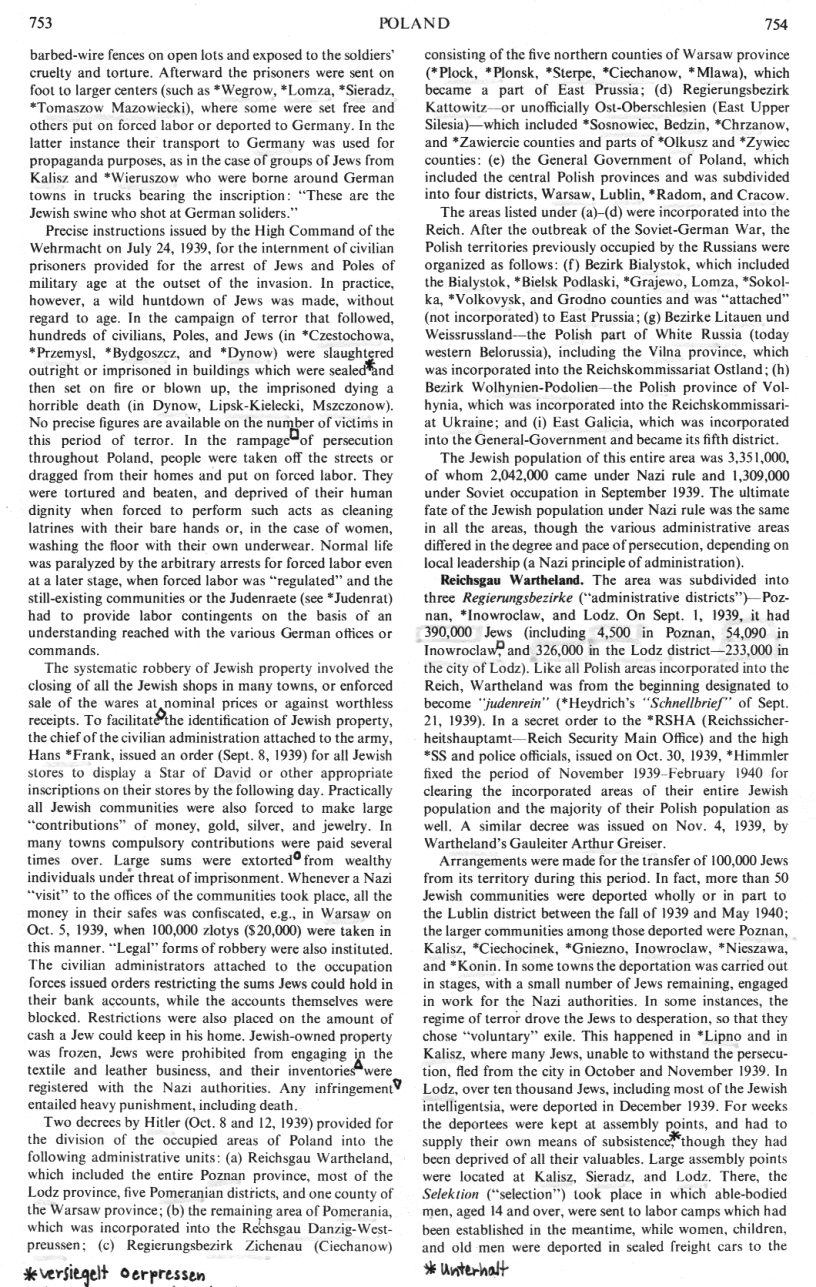
The area was subdivided into three Regierungsbezirke ("administrative districts") - Poznan, *Inowroclaw, and Lodz. On Sept. 1, 1939, it had 390,000 Jews (including 4,500 in Poznan, 54,090 in Inowroclaw [[Hohensalza]], and 326,000 in the Lodz district - 233,000 in the city of Lodz). Like all Polish areas incorporated into the Reich, Wartheland was from the beginning designated to become "judenrein" (*Heydrich's "Schnellbrief" [["Quick Letter"]] of Sept. 21, 1939). In a secret order to the *RSHA (Reichssicherheitshauptamt - Reich Security Main Office) and the high *SS and police officials, issued on Oct. 30, 1939, *Himmler fixed the period of November 1939-February 1940 for clearing the incorporated areas of their entire Jewish population and the majority of their Polish population as well. A similar decree was issued on Nov. 4, 1939, by Wartheland's Gauleiter Arthur Greiser.
Arrangements were made for the transfer of 100,000 Jews from its territory during this period. In fact, more than 50 Jewish communities were deported wholly or in part to the Lublin district between the fall of 1939 and May 1940; the larger communities among those deported were Poznan, Kalisz, *Ciechocinek, *Gniezno, Inowroclaw, *Nieszawa, and *Konin. In some towns the deportation was carried out in stages, with a small number of Jews remaining, engaged in work for the Nazi authorities.
[Deportations in the winter 1939-1940]
In some instances, the regime of terror drove the Jews to desperation, so that they chose "voluntary" exile. This happened in *Lipno and in Kalisz, where many Jews, unable to withstand the persecution, fled from the city in October and November 1939. In Lodz, over ten thousand Jews Jews, including most of the Jewish intelligentsia, were deported in December 1939. For weeks the deportees were kept at assembly points, and had to supply their own means of subsistence [[household money]], though they had been deprived of all their valuables. Large assembly points were located at Kalisz, Sieradz, and Lodz. There, the Selektion ("selection") took place in which able-bodied men, aged 14 and over, were sent to labor camps which had been established in the meantime, while women, children and old men were deported in sealed freight cars to the (col. 754)
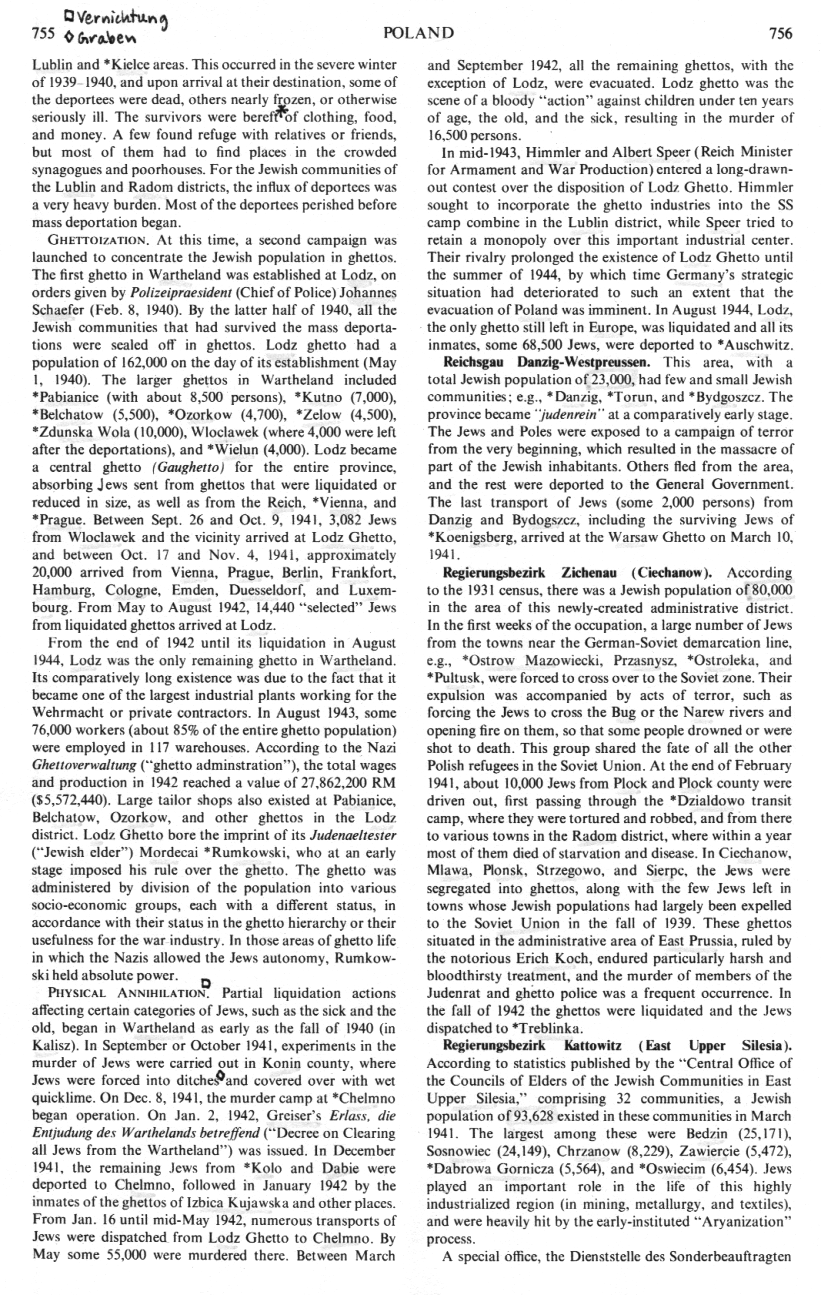
Lublin and *Kielce areas. This occurred in the severe winter of 1939-1940, and upon arrival at their destination, some of the deportees were dead, other nearly frozen, or otherwise seriously ill. The survivors were bereft [[robbed]] of clothing, food, and money. A few found refuge with relatives or friends, but most of them had to find places in the crowded synagogues and poorhouses. for the Jewish communities of the Lublin and Radom districts, the influx of deportees was a very heavy burden. Most of the deportees perished before mass deportation began.
GHETTOIZATION.
[Ghettos and numbers - Lodz ghetto for Jews from central Europe 1941-1942 - Lodz ghetto as a repair plant for the Wehrmacht 1942-1944]
At this time, a second campaign was launched to concentrate the Jewish population in ghettos. The first ghetto in Wartheland was established at Lodz, on orders given by Polizeipraesident (Chief of Police) Johannes Schaefer (Feb. 8, 1940). By the latter half of 1940, all the Jewish communities that had survived the mass deportations were sealed off in ghettos. Lodz ghetto had a population of 162,000 on the day of its establishment (May 1, 1940). The larger ghettos in Wartheland included *Pabianice (with about 8,500 persons), *Kutno (7,000), *Belchatow (5,500), *Ozorkow (4,700), *Zelow (4,500), *Zdunska Wola (10,000), Wloclawek (where 4,000 were left after the deportations), and *Wielun (4,000).
Lodz became a central ghetto (Gaughetto) for the entire province, absorbing Jews sent from ghettos that were liquidated or reduced in size, as well as from the Reich, *Vienna, and *Prague. Between Sept. 26 and Oct. 9, 1941, 3,082 Jews from Wloclawek and the vicinity arrived at Lodz Ghetto, and between Oct. 17 and Nov. 4, 1941, approximately 20,000 arrived from Vienna, Prague, Berlin, Frankfort, Hamburg, Cologne, Emden, Duesseldorf, and Luxembourg. From May to August 1942, 14,440 "selected" Jews from liquidated ghettos arrived at Lodz.
From the end of 1942 until its liquidation in August 1944, Lodz was the only remaining ghetto in Wartheland. Its comparatively long existence was due to the fact that it became one of the largest industrial plants working for the Wehrmacht or private contractors. In August 1943, some 76,000 workers (about 85% of the entire ghetto population) were employed in 117 warehouses. According to the Nazi Ghettoverwaltung ("ghetto administration"), the total wages and production in 1942 reached a value of 27,862,200 RM ($5,572,440). Large tailor shops also existed at Pabianice, Belchatow, Ozorkow, and other ghettos in the Lodz district. Lodz Ghetto bore the imprint of its Judenaeltester ("Jewish elder") Mordecai *Rumkowski, who at an early stage imposed his rule over the ghetto. The ghetto was administered by division of the population into various socio-economic groups, each with a different status, in accordance with their status in the ghetto hierarchy or their usefulness for the war industry. In those areas of ghetto life in which the Nazis allowed the Jews autonomy, Rumkowski held absolute power.
PHYSICAL ANNIHILATION.
[Mass murder in Chelmno since 8 December 1941 - Erlass [decree] of 2 January 1942 - deportations to ghettos and mass shooting sites]
Partial liquidation actions affecting certain categories of Jews, such as the sick and the old, began in Wartheland as early as the fall of 1940 (in Kalisz). In September or October 1941, experiments in the murder of Jews were carried out in Konin county, where Jews were forced into ditches and covered over with wet quicklime. On Dec. 8, 1941, the murder camp at *Chelmno began operation. On Jan. 2, 1942, Greiser's Erlass, die Entjudung des Warthelands betreffend ("Decree on Clearing all Jews from the Wartheland") was issued. In December 1941, the remaining Jews from *Kolo and Dabie were deported to Chelmno, followed in January 1942 by the inmates of the ghettos of Izbica Kujawska and other places. From Jan. 16 until mid-May 1942, numerous transports of Jews were dispatched from Lodz Ghetto to Chelmno. By May some 55,000 were murdered there. Between March (col. 755)
and September 1942, all the remaining ghettos, with the exception of Lodz, were evacuated. Lodz ghetto was the scene of a bloody "action" against children under ten years of age, the old, and the sick, resulting in the murder of 16,500 persons.
In mid-1943, Himmler and Albert Speer (Reich Minister for Armament and War Production) entered a long-drawnout contest over the disposition of Lodz Ghetto. Himmler sought to incorporate the ghetto industries into the SS camp combine in the Lublin district, while Speer tried to retain a monopoly over this important industrial center. Their rivalry prolonged the existence of Lodz Ghetto until the summer of 1944, by which time Germany's strategic situation had deteriorated to such an extent that the evacuation of Poland was imminent. In August 1944, Lodz, the only ghetto still left in Europe, was liquidated and all its inmates, some 68,500 Jews, were deported to *Auschwitz (col. 756)
[[and from there probably to the tunnel systems for underground weapon construction and underground oil plants or bunker systems for the Nazi government, with high death rates]].
Holocaust in Reichsgau Danzig-Westpreussen
<Reichsgau Danzig-Westpreussen. [Terror - massacre and flight - deportations]
This area, with a total Jewish population of 23,000, had few and small Jewish communities; e.g., *Danzig, *Torun, and *Bydgoszcz. The province became "judenrein" at a comparatively early stage. The Jews and Poles were exposed to a campaign of terror from the very beginning, which resulted in the massacre of part of the Jewish inhabitants. Other fled from the area, and the rest were deported to the General Gouvernment. The last transport of Jews (some 2,000 persons) from Danzig and Bydogszcz, including the surviving Jews of *Koenigsberg, arrived at the Warsaw Ghetto on March 10, 1941.> (col. 756)
Holocaust in Regierungsbezirk Zichenau (Ciechanow)
<Regierungsbezirk Zichenau (Ciechanow)
According to the 1931 census, there was a Jewish population of 80,000 in the area of this newly-created administrative district.
[[Between 1931 and 1939 there was an emigration movement of the young generation causing a low birth rate which is not mentioned. The flight movement to eastern Poland in 1939-1940 and the subsequent Stalin deportation to central Russia because of the resign of the Soviet passport is not mentioned. Add to this some Jews could hide in hideouts, by change of religion or by change of name with forged documents which were easy to get by Jewish organizations. So, it can be estimated that in total the number of Jews hit by the Nazi rule was 2/3 of the number of 1931, and a part of these were fighting as partisans]].
[Expulsion of Jews to the Soviet zone - expulsions to camps and towns - ghettos - torture, terror, and murder - deportation to Treblinka]
In the first weeks of the occupation, a large number of Jews from the towns near the German-Soviet demarcation line, e.g., *Ostrow Mazowiecki, Przasnysz, *Ostroleka, and *Pultusk, were forced to cross over to the Soviet zone. Their expulsion was accompanied by acts of terror, such as forcing the Jews to cross the Bug or the Narew rivers and opening fire on them, so that some people drowned or were shot to death. This group shared the fate of all the other Polish refugees in the Soviet Union [[e.g. deportation to central Russia, i.e. Siberia]].
At the end of February 1941, about 10,000 Jews from Plock and Plock county were driven out, first passing through the *Dzialdowo transit camp, where they were tortured and robbed, and from there to various towns in the Radom district, where within a year most of them died of starvation and disease. In Ciechanow, Mlawa, Plonsk, Strzegowo, and Sierpc, the Jews were segregated into ghettos, along with the few Jews left in towns whose Jewish populations had largely been expelled to the Soviet Union in the fall of 1939. These ghettos situated in the administrative area of East Prussia, ruled by the notorious Erich Koch, endured particularly harsh and bloodthirsty treatment, and the murder of members of the Judenrat and ghetto police was a frequent occurrence. In the fall of 1942 the ghettos were liquidated and the Jews dispatched to *Treblinka.> (col. 756)
Sources
Encyclopaedia Judaica (1971): Poland, vol. 13, col. 753-754
Encyclopaedia Judaica (1971): Poland, vol. 13, col. 755-756