Encyclopaedia Judaica
Jews in Poland 05-8: Holocaust and Jewish resistance
Self-defense - industries and smuggling - aid organizations - secret actions in the ghettos - fights and revolts
from: Poland; In: Encyclopaedia Judaica 1971, vol. 13
presented by Michael Palomino (2008 / 2020)
Share:
<Jewish Resistance.
[The Jewish system of self-defense - secret industries in the ghettos - smuggling - the will to live]
Nazi plans called for a campaign of (col. 771)
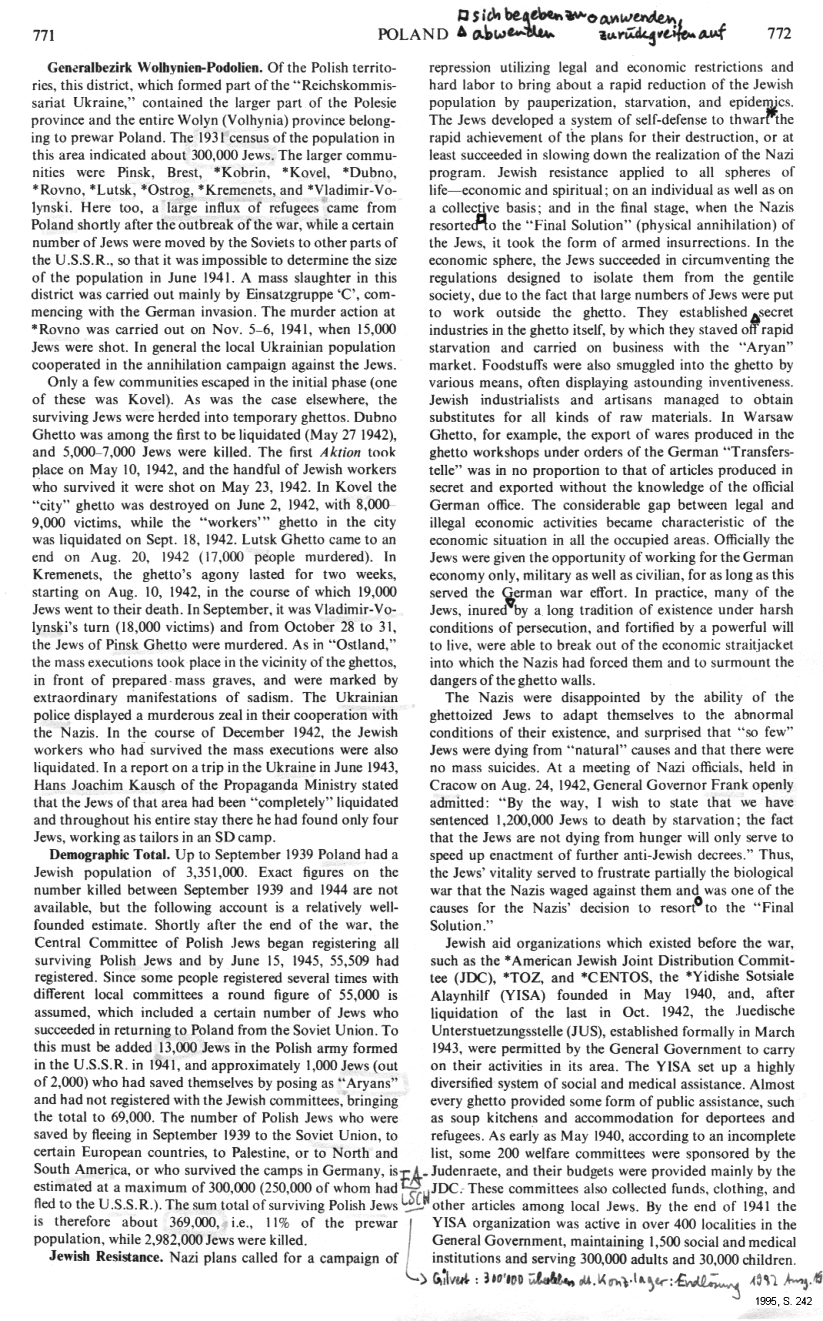
repression utilizing legal and economic restrictions and hard labor to bring about a rapid reduction of the Jewish population by pauperization, starvation, and epidemics. The Jews developed a system of self-defense to thwart [[hinder]] the rapid achievement of the plans for their destruction, or at least succeeded in slowing down the realization of the Nazi program. Jewish resistance applied to all spheres of life - economic and spiritual; on an individual as well as on a collective basis; and in the final stage, when the Nazis resorted [[began]] to the "Final Solution" (physical annihilation) of the Jews, it took the form of armed insurrections.
In the economic sphere, the Jews succeeded in circumventing the regulations designed to isolate them from the gentile society, due to the fact that large numbers of Jews were put to work outside the ghetto. They established secret industries in the ghetto itself, by which they staved off [[could evade]] rapid starvation and carried on business with the "Aryan" market. Foodstuffs were also smuggled into the ghetto by various means, often displaying astounding inventiveness Jewish industrialists ans artisans managed to obtain substitutes for all kinds of raw materials.
In Warsaw Ghetto, for example, the export of wares produced in the ghetto workshops under orders of the German "Transferstelle" [[Transfer Center]] was in no proportion to that of articles produced in secret and exported without the knowledge of the official German office. The considerable gap between legal and illegal economic activities became characteristic of the economic situation in all the occupied areas.
Officially the Jews were given the opportunity of working for the German economy only, military as well as civilian, for as long as this served the German war effort. In practice, many of the Jews, inured [[trained]] by a long tradition of existence under harsh conditions of persecution, and fortified by a powerful will to live, were able to break out of the economic straitjacket into which the Nazis had forced them and to surmount the dangers of the ghetto walls.
[Nazi government is surprised of Jewish will to live]
The Nazis were disappointed by the ability of the ghettoized Jews to adapt themselves to the abnormal conditions of their existence, and surprised that "so few" Jews were dying from "natural" causes and that there were no mass suicides. At t meeting of Nazi officials, held in Cracow on Aug. 24, 1942, General Governor Frank openly admitted:
"By the way, I wish to state that we have sentenced 1,200,000 Jews to death by starvation; the fact that the Jews are not dying from hunger will only serve to speed up enactment of further anti-Jewish decrees."
Thus, the Jews' vitality served to frustrate partially the biological war that the Nazis waged against them and was one of the causes for the Nazis' decision to resort [[to plan]] to the "Final Solution".
[Jewish aid organizations in the Jewish ghettos permitted - up to 60% dependency - hunger and death]
Jewish aid organizations which existed before the war, such as the *American Jewish Joint Distribution Committee (JDC), *TOZ, and *CENTOS, the *Yidishe Sotsiale Alaynhilf [[Yiddish Social Help]] (YISA) founded in May 1940, and, after liquidation of the last in Oct. 1942, the Juedische Unterstuetzungsstelle [[Jewish Support Center]] (JUS), established formally in March 1943, were permitted by the General Government to carry on their activities in its area. The YISA set up a highly diversified system of social and medical assistance. Almost every ghetto provided some form of public assistance, such as soup kitchens and accommodation for deportees and refugees.
As early as May 1940, according to an incomplete list, some 200 welfare committees were sponsored by the Judenraete [[Jewish Councils]], and their budgets were provided mainly by the JDC [[Joint]]. These committees also collected funds, clothing, and other articles among local Jews. By the end of 1941 the YISA [[Yidishe Sotsiale Alaynhilf]] organization was active in over 400 localities in the General Government, maintaining 1,500 social and medical institutions and serving 300,000 adults and 30,000 children. (col. 772)
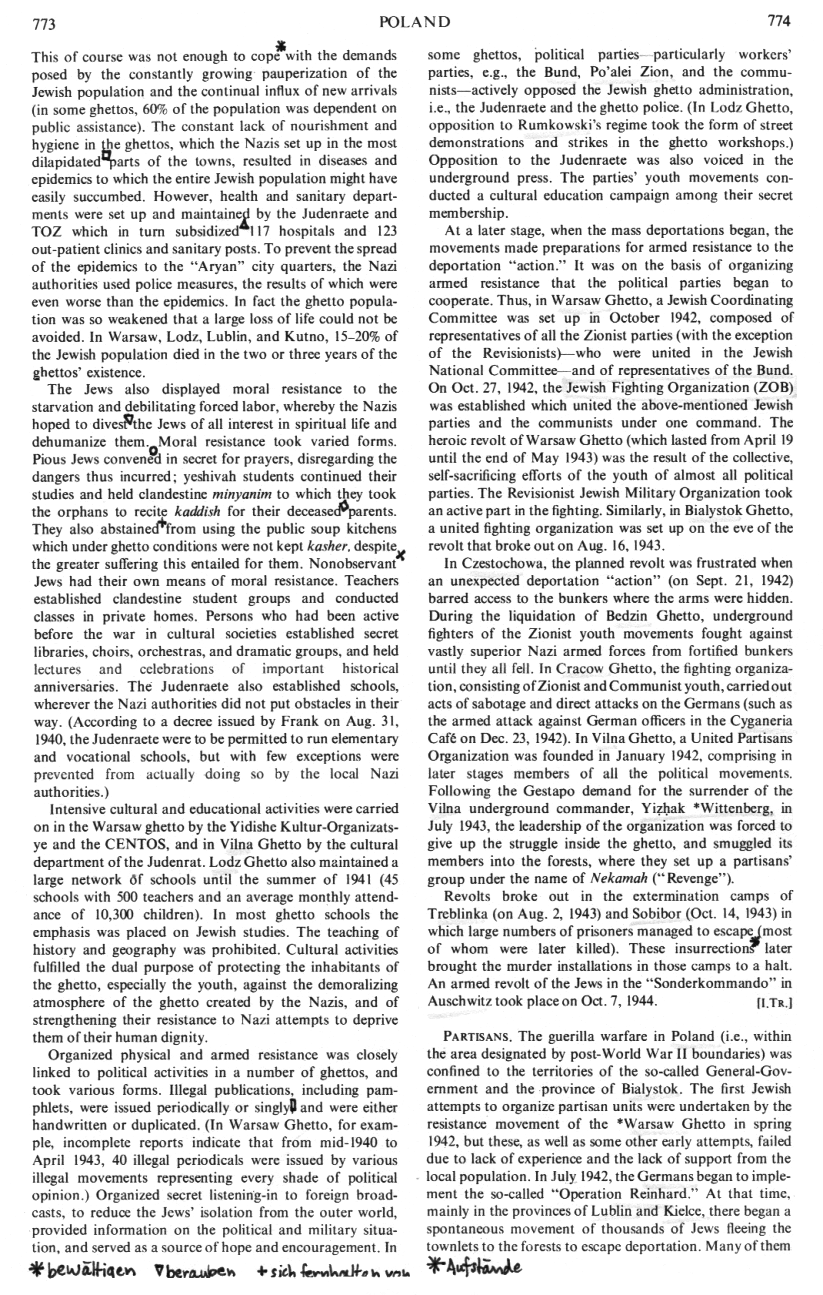
This of course was not enough to cope [[to counter]] with the demands posed by the constantly growing pauperization of the Jewish population and the continual influx of new arrivals (in some ghettos, 60% of the population was dependent on public assistance). The constant lack of nourishment and hygiene in the ghettos, which the Nazis set up in the most dilapidated [[old without repair]] parts of the towns, resulted in diseases and epidemics to which the entire Jewish population might have easily succumbed.
However, health and sanitary departments were set up and maintained by the Judenraete [[Jewish Councils]] and TOZ which in turn subsidized [[supported]] 117 hospitals and 123 out-patient clinics and sanitary posts.
To prevent the spread of the epidemics to the "Aryan" city quarters, the Nazi authorities used police measures, the results of which were even worse than the epidemics. In fact the ghetto population was so weakened that a large loss of life could not be avoided. In Warsaw, Lodz, Lublin, and Kutno, 15-20% of the Jewish population died in the two or three years of the ghettos' existence.
[[Large parts of the Jewish population in Poland (1 mio.) were at the margin of a hunger epidemic in 1938 already by the long-lasting discriminations under the anti-Semitic Polish regime, see: Joint]].
[Ghetto kitchens - secret schooling - secret festivals - prohibition of schooling - cultural activities - secret newspapers]
The Jews also displayed moral resistance to the starvation and debilitating forced labor, whereby the Nazis hoped to divest [[loot]] the Jews of all interest in spiritual life and dehumanize them. Moral resistance took varied forms. Pious Jews convened [[gathered]] in secret for prayers, disregarding the dangers thus incurred; yeshivah [[religious Torah school]] students continued their studies and held clandestine minyanim [[worship services]] to which they took the orphans to recite kaddish [[central Jewish prayer for the Lord]] for their deceased [[dead]] parents. They also abstained [[resign]] from using the public soup kitchens which under ghetto conditions were not kept kasher, despite the greater suffering this entailed for them.
Nonobservant Jews had their own means of moral resistance. Teachers established clandestine student groups and conducted classes in private homes. Persons who had been active before the war in cultural societies established secret libraries, choirs, orchestras, and dramatic groups, and held lectures and celebrations of important historical anniversaries. The Judenraete [[Jewish Councils]] also established schools, wherever the Nazi authorities died not put obstacles in their way. (According to a decree issued by Frank on Aug. 31, 1940, the Judenraete were to be permitted to run elementary and vocational schools, but with few exceptions were prevented from actually doing so by the local Nazi authorities).
Intensive cultural and educational activities were carried on in the Warsaw ghetto by the Yidishe Kultur-Organizatsye and the CENTOS, and in Vilna Ghetto by the cultural department of the Judenrat. Lodz Ghetto also maintained a large network of schools until the summer of 1941 (45 schools with 500 teachers and an average monthly attendance of 10,300 children). In most ghetto schools the emphasis was placed on Jewish studies. The teaching of history and geography was prohibited. Cultural activities fulfilled the dual purpose of protecting the inhabitants of the ghetto, especially the youth, against the demoralizing atmosphere of the ghetto created by the Nazis [[and their collaborators]], and of strengthening their resistance to Nazi attempts to deprive them of their human dignity.
[[Some German soldiers who did not want any murder also helped smuggling for the Jewish side. This is not mentioned]].
Organized physical and armed resistance was closely linked to political activities in a number of ghettos, and took various forms. Illegal publications, including pamphlets, were issued periodically or singly [[only one edition]] and were either handwritten or duplicated. (In Warsaw Ghetto, for example, incomplete reports indicate that from mid-1940 to April 1943, 40 illegal periodicals were issued by various illegal movements representing every shade of political opinion). Organized secret listening-in to foreign broadcasts, to reduce the Jews' isolation from the outer world, provided information on the political and military situation, and served as a source of hope and encouragement. (col. 773)
[[In war times it's natural that there is much propaganda and by this also the Jewish underground press was full of propaganda and wrong information. News which gave the more hope were promoted also when the news were wrong etc., which is not mentioned]].
[Jewish resistance against the Jewish Councils]
In (col. 774)
some ghettos, political parties - particularly workers' parties, e.g., the [[Socialist party]] Bund, [[racist Zionist]] Po'alei Zion, and the communists - actively opposed the Jewish ghetto administration, i.e., the Judenraete [[Jewish Councils]] and the ghetto police. (In Lodz Ghetto, opposition to Rumkowski's regime took the form of street demonstrations and strikes in the ghetto workshops). Opposition to the Judenraete was also voiced in the underground press. The parties' youth movements conducted a cultural education campaign among their secret membership.
At a later stage, when the mass deportations began, the movements made preparations for armed resistance to the deportation "action". It was on the basis of organizing armed resistance that the political parties began to cooperate. Thus, in Warsaw Ghetto, a Jewish Coordinating Committee was set up in October 1942, composed of representatives of all the [[racist]] Zionist parties (with the exception of the Revisionists) - who were united in the Jewish National Committee - and of representatives of the Bund.
[Armed resistance - fights in Warsaw, Bialystok, Czestochowa, Bedzin, Cracow, Vilna - revolts in Treblinka, Sobibor, and Auschwitz]
On Oct. 27, 1942, the Jewish Fighting Organization (ZOB) was established which united the above-mentioned Jewish parties and the communists under one command. The heroic revolt of Warsaw Ghetto (which lasted from April 19 until the end of May 1943) was the result of the collective, self-sacrificing efforts of the youth of almost all political parties. The Revisionist Jewish Military Organization took an active part in the fighting.
Similarly, in Bialystok Ghetto, a united fighting organization was set up on the eve of the revolt that broke out on Aug. 16, 1943.
In Czestochowa, the planned revolt was frustrated when an unexpected deportation "action" (on Sept. 21, 1942) barred access to the bunkers where the arms were hidden.
During the liquidation of Bedzin Ghetto, underground fighters of the [[racist]] Zionist youth movements fought against vastly superior Nazi armed forces from fortified bunkers until they all fell.
In Cracow Ghetto, the fighting organization, consisting of [[racist]]Zionists and Communist youth, carried out acts of sabotage and direct attacks on the Germans (such as the armed attack against German officers in the Cyganeria Café on Dec. 23, 1942).
In Vilna Ghetto, a United Partisans Organization was founded in January 1942, comprising in later stages members of all the political movements. Following the Gestapo demand for the surrender of the Vilna underground commander, Yizhak (Yiẓḥak) *Wittenberg, in July 1943, the leadership of the organization was forced to give up the struggle inside the ghetto, and smuggled its members into the forests, where they set up a partisans' group under the name of Nekamah ("Revenge").
Revolts broke out in the extermination camps of Treblinka (on Aug. 2, 1943) and Sobibor (Oct. 14, 1943) in which large numbers of prisoners managed to escape (most of whom were later killed). These insurrections [[revolts]] later brought the murder installations in those camps to a halt. An armed revolt of the Jews in the "Sonderkommando" in Auschwitz took place on Oct. 7, 1944.
[I.TR.]> (col. 774)
Sources
Encyclopaedia Judaica (1971): Poland, vol. 13, col. 771-772
Encyclopaedia Judaica (1971): Poland, vol. 13, col. 773-774