Encyclopaedia Judaica
Jews in Poland 05-4: Holocaust in Bialystok district
Sovietization 1939-1941 - Jewish refugees - Nazi administration by East Prussia 1941-1944 - massacres - overcrowded ghettos - resistance
from: Poland; In: Encyclopaedia Judaica 1971, vol. 13
presented by Michael Palomino (2008 / 2020)
Share:
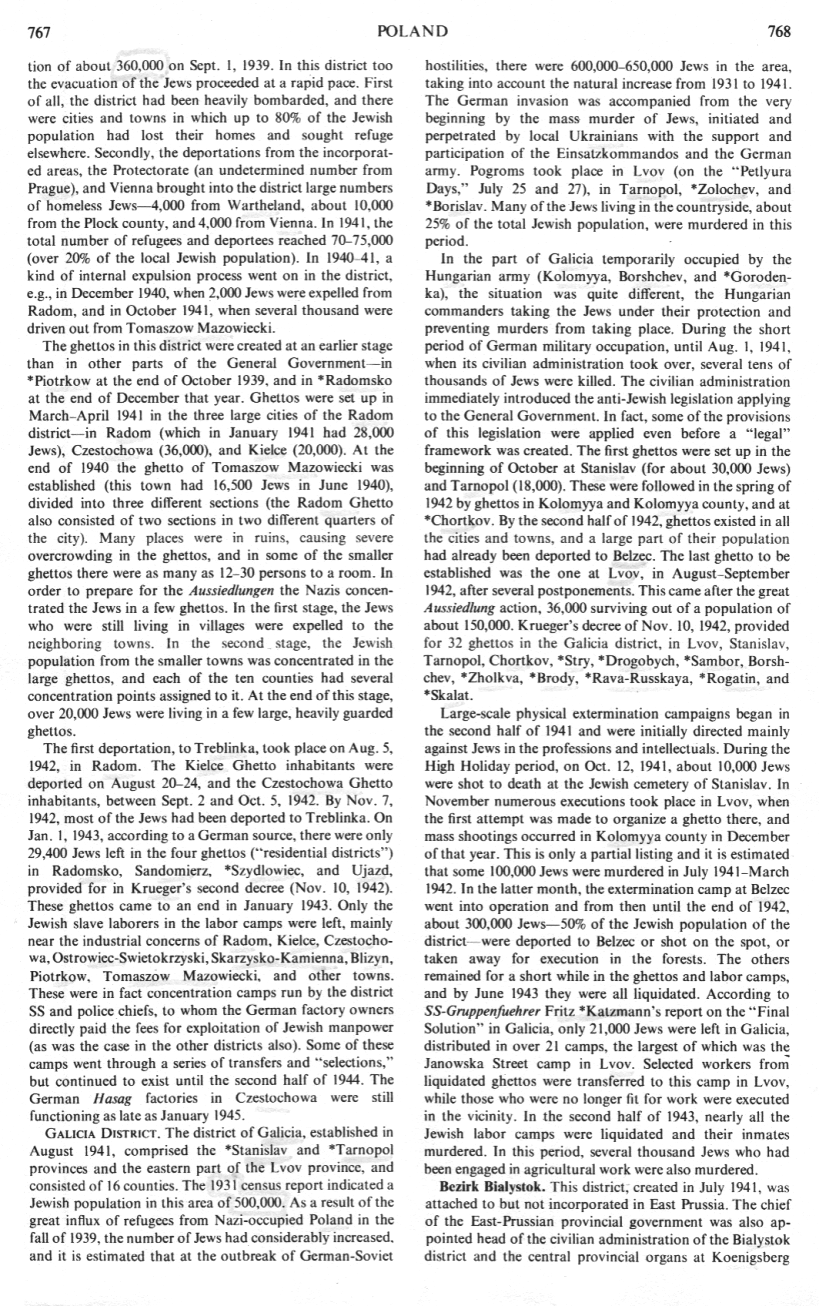
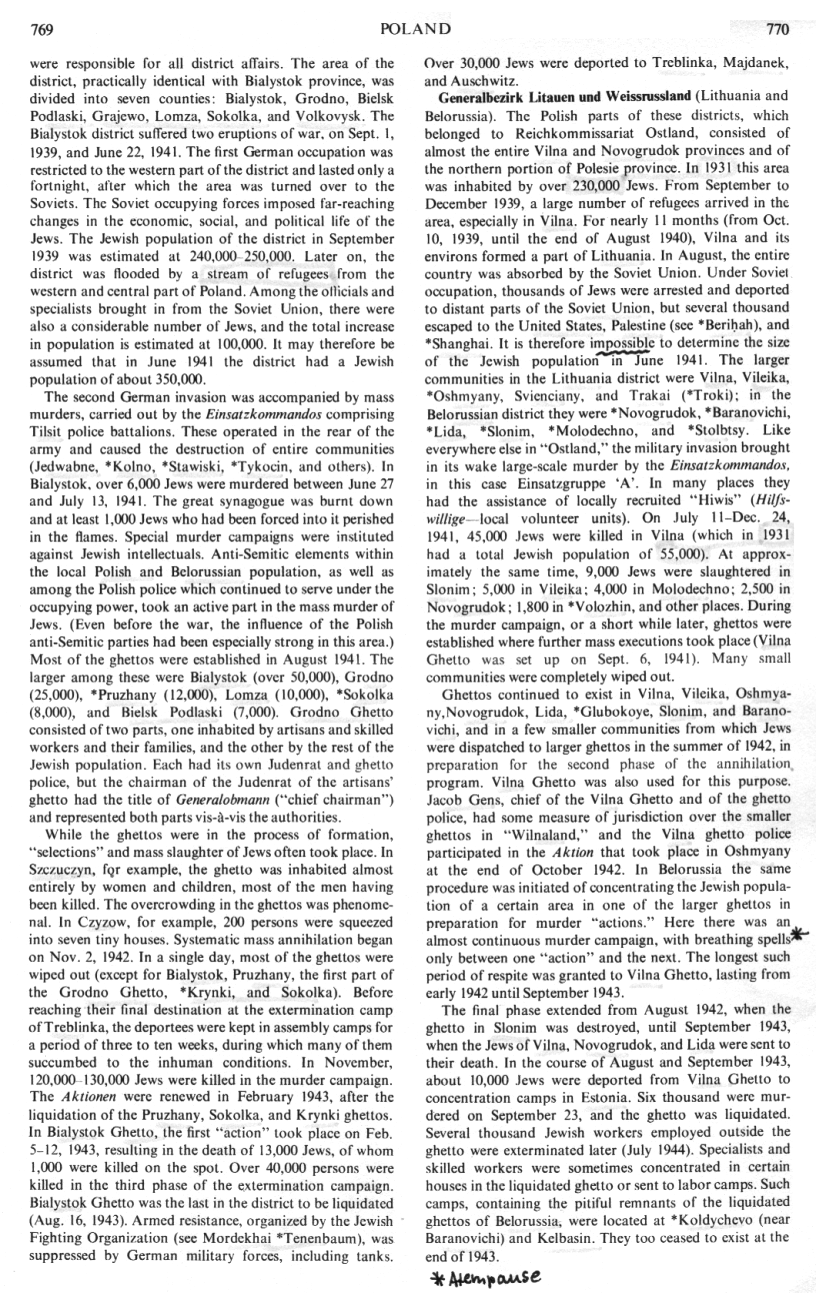
<Bezirk Bialystok [Bialystok district].
[[...]]
[Sovietization 1939-1941 - influx of Jewish refugees from western and central Poland - Soviet administration with many Jews]
The first German occupation was restricted to the western part of the district and lasted only a fortnight, after which the area was turned over to the Soviets. The Soviet occupying forces imposed far-reaching changes in the economic, social, and political life of the Jews. The Jewish population of the district in September 1939 was estimated at 240,000-250,000.
[[This number seems to be much too high considering the emigration wave of the young generation and the low birthrate of 1931-1939]].
Later on, the district was flooded by a stream of refugees from the western and central part of [[German occupied]] Poland. Among the officials and specialists brought in from the Soviet Union, there were also a considerable number of Jews, and the total increase in population is estimated at 100,000. It may therefore be assumed that in June 1941 the district had a Jewish population of about 350,000.
[[Stalin deportations are not mentioned. Also the flight movement to Lithuania is not mentioned. And the Big Flight from Barbarossa with the withdrawal of the Russian army with the administration and the industrial staff with many Jews is not mentioned either. It can be estimated that the number of Jews was only 1/2 of the number above because the Jews knew what signified the Nazi occupation in combination with the anti-Semitic Polish population]].
[Nazi occupation - Prussian administration - massacres and the collaborators]
The second German invasion was accompanied by mass murders, carried out by the Einsatzkommandos comprising Tilsit police battalions. These operated in the rear of the army and caused the destruction of entire communities (Jedwabne [[the anti-Semitic Polish population eliminated the Jews of Jedwabne without German order]], *Kolno, *Stawiski, *Tykocin, and others). In Bialystok, over 6,000 Jews were murdered between June 27 and July 13, 1941. The great synagogue was burnt down and at least 1,000 Jews who had been forced into it perished in the flames. Special murder campaigns were instituted against Jewish intellectuals. Anti-Semitic elements within the local Polish and Belorussian population, as well as among the Polish police which continued to serve under the occupying power, took an active part in the mass murder of Jews. (Even before the war, the influence of the Polish anti-Semitic parties had been especially strong in this area). (col. 769)
[Attached to East Prussia - administration by the East-Prussian government]
The district, created in July 1941, was attached to but not incorporated in East Prussia. The chief of the East-Prussian provincial government was also appointed head of the civilian administration of the Bialystok district and the central provincial organs at Koenigsberg (col. 768)
were responsible for all district affairs. The area of the district, practically identical with Bialystok province, was divided into seven counties: Bialystok, Grodno, Bielsk, Podlaski, Grajewo, Lomza, Sokolka, and Volkovysk. The Bialystok district suffered two eruptions of war, on Sept. 1, 1939, and June 22, 1941. (col. 769)
[Ghettos with Jewish Council and ghetto police - massacres - overcrowded ghettos - resistance]
Most of the ghettos were established in August 1941. The larger among these were Bialystok (over 50,000), Grodno (5,000), *Pruzhany (12,000), Lomza (10,000), *Sokolka (8,000), and Bielsk Podlaski (7,000). Grodno Ghetto consisted of two parts, one inhabited by artisans and skilled workers and their families, and the other by the rest of the Jewish population. Each had its own Judenrat [[Jewish Council]] and ghetto police, but the chairman of the Judenrat of the artisans' ghetto had the title of Generalobmann ("chief chairman") and represented both parts vis-à-vis the authorities.
While the ghettos were in the process of formation, "selections" and mass slaughter of Jews often took place. In Szczyczyn, for example, the ghetto was inhabited almost entirely by women and children, most of the men having been killed.
The overcrowding in the ghettos was phenomenal. In Czyzow, for example, 200 persons were squeezed into seven tiny houses. Systematic mass annihilation began on Nov. 2, 1942. In a single day,most of the ghettos were wiped out (except for Bialystok, Pruzhany, the first part of the Grodno Ghetto, *Krynki, and Sokolka). Before reaching their final destination at the extermination camp of Treblinka, the deportees were kept in assembly camps for a period of three to ten weeks, during which many of them succumbed to the inhuman conditions. In November, 120,000-130,000 Jews were killed in the murder campaign. The Aktionen were renewed in February 1943, after the liquidation of the Pruzhany, Sokolka, and Krynki ghettos. In Bialystok Ghetto, the first "action" took place on Feb. 5-12, 1943, resulting in the death of 13,000 Jews, of whom 1,000 were killed on the spot. Over 40,000 persons were killed in the third phase of the extermination campaign.
Bialystok Ghetto was the last in the district to be liquidated (Aug. 16, 1943). Armed resistance, organized by the Jewish Fighting Organization (see Mordekhai *Tenenbaum), was suppressed by German military forces, including tanks. (col. 769)
Over 30,000 Jews were deported to Treblinka, Majdanek, and Auschwitz.> (col. 770)
[[From there they were probably deported to the tunnel systems for underground weapon construction and underground oil plants or bunker systems for the Nazi government, with high death rates]].
Sources
Encyclopaedia Judaica (1971): Poland, vol. 13, col. 767-768
Encyclopaedia Judaica (1971): Poland, vol. 13, col. 769-770