Encyclopaedia Judaica
Jews in Poland 05-5: Holocaust in Polish parts of Lithuania and Belarus
Sovietization - Nazi rule with massacres - ghettos - deportations
from: Poland; In: Encyclopaedia Judaica 1971, vol. 13
presented by Michael Palomino (2008 / 2020)
Share:
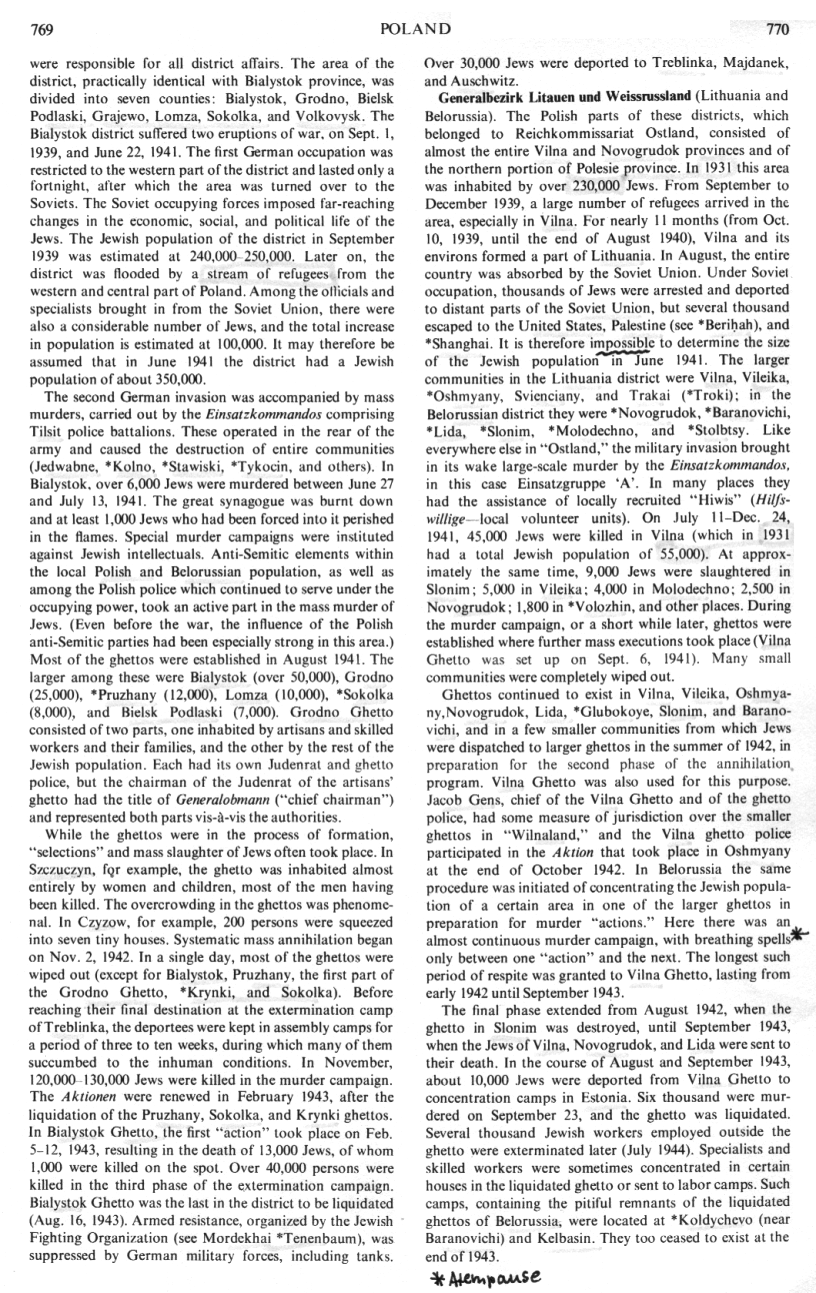
<Generalbezirk Litauen und Weissrussland (Lithuania and Belorussia [today: Belarus]).
The Polish parts of these districts, which belonged to Reichskommissariat Ostland, consisted of almost the entire Vilna and Novogrudok provinces and of the northern portion of Polesie province. In 1931 this area was inhabited by over 230,000 Jews.
[[Between 1931 and 1939 there was an emigration movement of the young Jewish generation causing a low birth rate which is not mentioned. The flight movement to eastern Poland in 1939-1940 and the subsequent Stalin deportation to central Russia because of the resign of the Soviet passport is not mentioned. Add to this some Jews could hide in hideouts, by change of religion or by change of name with forged documents which were easy to get by Jewish organizations. So, it can be estimated that in total the number of Jews hit by the Nazi rule was 2/3 of the number of 1931, and a part of these were fighting as partisans]].
[Independent Lithuania 1939-1940 - sovietization of Lithuania 1940-1941]
From September to December 1939, a large number of refugees arrived in the area, especially in Vilna [[for emigration]]. For nearly 11 months (from Oct. 10, 1939, until the end of August 1940), Vilna and its environs formed a part of Lithuania. In August, the entire country was absorbed by the Soviet Union [[and emigration was stopped]]. Under Soviet occupation, thousands of Jews were arrested and deported to distant parts of the Soviet Union, but [[1939-1940]] several thousand escaped to the United States, Palestine (see *Berihah (Beriḥah)), and *Shanghai. It is therefore impossible to determine the size of the Jewish population in June 1941.
[[The Big Flight from Barbarossa in June 1941 with the withdrawal of the Russian army with all Communist administration and industrial staff with many Jews is not mentioned in the article]].
[Massacres - ghettos - deportations to Estonia]
The larger communities in the Lithuania district were Vilna, Vileika, *Oshmyany, Svienciany, and Trakai (*Troki); in the Belorussian district they were *Novogrudok, *Baranovichi, *Lida, *Slonim, *Molodechno, and *Stolbtsy. Like everywhere else in "Ostland", the military invasion brought in its wake large-scale murder by the Einsatzkommandos, in this case Einsatzgruppe 'A'. In many places they had the assistance of locally recruited "Hiwis" (Hilfswillige - local volunteer units).
On July 11-Dec. 24, 1941, 45,000 Jews were killed in Vilna (which in 1931 hat a total Jewish population of 55,000).
[[There is to consider the emigration wave 1931-1939, the Stalin deportations 1940-1941 and the Big Flight from Barbarossa of 1941, add to this the hideouts, changing name and changing religion. So the number of 55,000 Jews in Vilna seems to be much too high for 1941 and the number of 45,000 Jews killed in Vilna also seems to be much too high]].
At approximately the same time, 9,000 Jews were slaughtered in Slonim; 5,000 in Vileika; 4,000 in Molodechno; 2,500 in Novogrudok; 1,800 in *Volozhin, and other places. During the murder campaign, or a short while later, ghettos were established where further mass executions took place (Vilna Ghetto was set up on Sept.6, 1941). Many small communities were completely wiped out.
Ghettos continued to exist in Vilna, Vileika, Oshmyany, Novogrudok, Lida, *Glubokoye, Slonim, and Baranovichi, and in a few smaller communities from which Jews were dispatched to larger ghettos in the summer of 1942, in preparation for the second phase of the annihilation program. Vilna Ghetto was also used for this purpose. Jacob Gens, chief of the Vilna Ghetto and of the ghetto police, had some measure of jurisdiction over the smaller ghettos in "Wilnaland", and the Vilna ghetto police participated in the Aktion that took place in Oshmyany at the end of October 1942.
[Holocaust in Polish parts of Belarus]
In Belorussia [[during the Nazi times: Weissruthenien, White Rutenia]] the same procedure was initiated of concentrating the Jewish population of a certain area in one of the larger ghettos in preparation for murder "actions". Here there was an almost continuous murder campaign, with breathing spells [[little breaks]] only between one "action" and the next. The longest such period of respite was granted to Vilna Ghetto, lasting from early 1942 until September 1943.
The final phase extended from August 1942, when the ghetto in Slonim was destroyed, until September 1943, when the Jews of Vilna, Novogrudok, and Lida were sent to their death. In the course of August and September 1943, about 10,000 Jews were deported from Vilna Ghetto to concentration camps in Estonia. Six thousand were murdered on September 23, and the ghetto was liquidated. Several thousand Jewish workers employed outside the ghetto were exterminated later (July 1944). Specialists and skilled workers were sometimes concentrated in certain houses in the liquidated ghetto or sent to labor camps. Such camps, containing the pitiful remnants of the liquidated ghettos of Belorussia, were located at *Koldychevo (near Baranovichi) and Kelbasin. They too ceased to exist at the end of 1943.> (col. 770)
Sources
Encyclopaedia Judaica (1971): Poland, vol. 13, col. 769-770