Encyclopaedia Judaica
Jews in Poland 05-6: Holocaust in Volhynia-Podolia
Jewish refugees - Sovietization - Stalin deportations - Nazi occupation and collaboration - massacres - ghettos
from: Poland; In: Encyclopaedia Judaica 1971, vol. 13
presented by Michael Palomino (2008 / 2020)
Share:
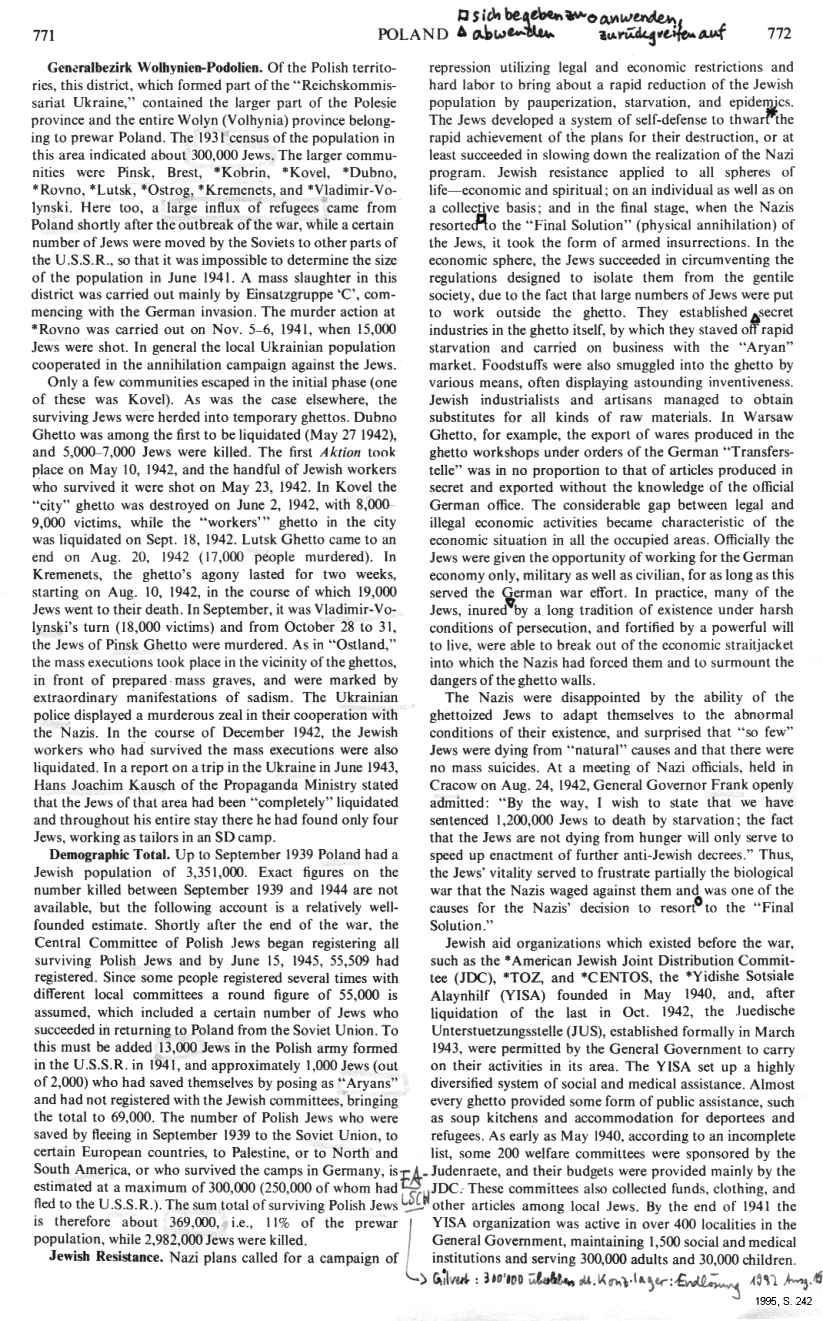
<Generalbezirk Wolhynien-Podolien [general district Volhynia Podolia].
Of the Polish territories, this district, which formed part of the "Reichskommissariat Ukraine", contained the larger part of the Polesie province and the entire Wolyn (Volhynia) province belonging to prewar Poland. The 1931 census of the population in this area indicated about 300,000 Jews.
[[Between 1931 and 1939 there was an emigration movement of the young generation causing a low birth rate which is not mentioned]].
[Jewish refugees from western and central Poland 1939-1940 - Sovietization and Stalin deportations]
The larger communities were Pinsk, Brest, *Kobrin, *Kovel, *Dubno, *Rovno, *Lutsk, *Ostrog, *Kremenets, and *Vladimir-Volynski. Here too, a large influx of refugees came from Poland shortly after the outbreak of the war, while a certain number of Jews were moved by the Soviets to other parts of the U.S.S.R., so that it was impossible to determine the size of the population in June 1941.
[[The flight movement to eastern Poland in 1939-1940 and the subsequent Stalin deportations to central Russia because of the resign of the Soviet passport is not mentioned. Add to this there were more Stalin deportations against class enemies with many Jews. In June 1941 there was the Big Flight from Barbarossa of the Russian army with all Communist administration and industrial staff with many Jews. Add to this some Jews could hide in hideouts, by change of religion or by change of name with forged documents which were easy to get by Jewish organizations. So, it can be estimated that in total the number of Jews hit by the Nazi rule was 2/3 of the number of 1931, and a part of these were fighting as partisans]].
[Nazi occupation 1941-1945 - massacres and ghettos in collaboration with Ukrainian police]
A mass slaughter in this district was carried out mainly by Einsatzgruppe 'C', commencing with the German invasion.
[[There were pogroms by the local population already between the withdrawal of the Russian army and the German invasion]].
The murder action at *Rovno was carried out on Nov. 5-6, 1941, when 15,000 Jews were shot. In general the local Ukrainian population cooperated in the annihilation campaign against the Jews.
Only a few communities escaped in the initial phase (one of these was Kovel). As was the case elsewhere, the surviving Jews were herded into temporary ghettos. Dubno Ghetto was among the first to be liquidated (May 27 1942), and 5,000-7,000 Jews were killed. The first Aktion took place on May 10, 1942, and the handful of Jewish workers who survived it were shot on May 23, 1942. In Kovel the "city" ghetto was destroyed on June 2, 1942, with 8,000-9,000 victims, while the "workers' " ghetto in the city was liquidated on Sept. 18, 1942. Lutsk Ghetto came to an end on Aug. 20, 1942 (17,000 people murdered). In Kremenets, the ghetto's agony lasted for two weeks, starting on Aug. 10, 1942, in the course of which 19,000 Jews went to their death.
In September, it was Vladimir-Volynski's turn (18,000 victims) and from October 28 to 31, the Jews of Pinsk Ghetto were murdered. At in "Ostland", the mass executions took place in the vicinity of the ghettos, in front of prepared mass graves, and were marked by extraordinary manifestations of sadism. The Ukrainian police displayed a murderous zeal in their cooperation with the Nazis.
[[The German occupation administration had a racist system to rate the collaborators. First were the Baltes, then the Ukrainians, and then the Belorussians]].
In the course of December 1942, the Jewish workers who had survived the mass executions were also liquidated. In a report on a trip in the Ukraine in June 1943, Hans Joachim Kausch of the Propaganda Ministry stated that the Jews of that area had been "completely" liquidated and throughout his entire stay there he had found only four Jews, working as tailors in an SD camp.> (col. 771)
Sources
Encyclopaedia Judaica (1971): Poland, vol. 13, col. 771-772