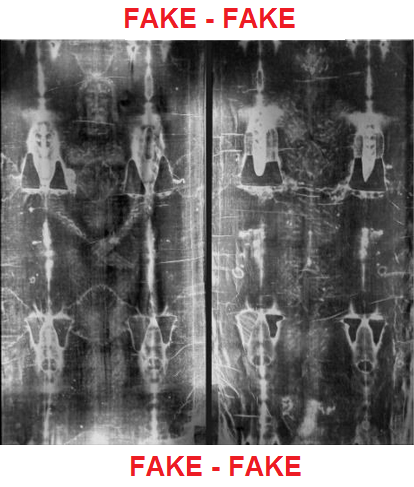
6. Summary: The fake spots on the
fake Shroud of Turin
-- The cloth is made of flax, which was produced in Europe
between 1260 and 1390
-- In 2018, the two researchers Matteo Borrini and Luigi
Garlaschelli wanted to find out with forensic analytical
means whether the spots on the tomb cloth are realistic or
painted
-- The researcher Luigi Garlaschelli was experimenting on
his own body simulating blood wounds, wrapped up with a
cloth of the same quality
-- All possible positions were simulated, horizontal,
vertical etc.
-- The conclusion is clear: at least 50% of the spots on
the so-called "Shroud of Turin" are a FAKE, are pure
FANTASY and are smeared by hand or painted with brushes.
--The crap is just another FAKE as everything is FAKE in
the criminal pedophile-satanic gay Church.
Michael Palomino, 7.8.2022
The Shroud is also
FAKE: the blood stains are at the wrong place -
investigation 2018

July 16, 2018: Experts
from Italy+GB: The Shroud of Turin is a FAKE: the blood
stains are not where they should be
Enigmatic Jesus reliquary: Turin grave towel is said to
be a fake
(orig. German: Rätselhafte
Jesus-Reliquie: Turiner Grabtuch soll eine Fälschung
sein)
https://de.sputniknews.com/zeitungen/20180716321584446-Turiner-gruch-echtkeit/
Translation:
<Experts from Italy and Great Britain tend to assume
that the Turin Grave towel (Shroud of Turin) is a fake.
They came to this conclusion after examining the bruises
on the body of Christ with the help of a doll. The
blood stains on the shroud are located in other places
than they should have been.
But how these spots were painted on the cloth and
what fabric it is remains unclear for the time being.
The analysis of the blood stains on the Turin
Shroud showed that they could not possibly be left
behind from a body wrapped in the cloth.
This is the conclusion of at least the anthropologist
Mr. Matteo Borrini from Liverpool John Moores
University and the chemist Mr. Luigi Garlaschelli. The
results were published in the "Journal of Forensic
Sciences" (link).
The Turin Shroud is a Christian sanctuary - a four
-meter cloth, into which the body of Jesus Christ was
supposedly wrapped after his death.
Some of the believers are convinced that there are
real traces of the face and body of Christ on the
towel, so that the Turin Shroud is one of the greatest
relics in Christianity. Some representatives of the
Church also consider the cloth for real. The cloth has
been examined several times to confirm or refute its
authenticity.
[The invention of a cloth with blood stains -
"discovered" in France in 1353]
The relic was discovered in France in 1353. First it
was exposed by Geoffroy de Charny in the city of Lirey
near Troyes in the Champagne. In 1452, King Ludwig
of Savoy bought the grave towel, which has been
kept in Chambéry since then. In 1532 it was damaged in
a fire.
In 1898, when the towel was exposed, a photographer
Mr. Secondo Pia took some pictures and discovered the
traces of a human face on the negatives. This
discovery triggered a number of questions that
primarily concerned the authenticity of the cloth and
of the person being depicted on it. But correct
investigations could only be carried out in the late
20th century.
[Red liquid with iron oxide - can be color, blood
can be]
Until that day, it was not possible yet to find out
where the blood stains on the Shroud come from (or if
it is really blood at all). It was only stated that
there is iron oxide in it.
["Shroud" of Turin was produced between 1275 and
1381]
This liquid could have come on the cloth also by
painting. And in 1988 it was found out that this cloth
had been produced between 1275 and 1381. But these
data were often criticized: some experts are convinced
that the accuracy of this fixing of age could be
influenced by the content of the oils in the cloth
with which it was severely soaked in 1532. In
addition, the cloth was exposed to enormously high
temperatures during the fire mentioned.
["Grave towel" was approx. 33 BC. Plus / minus 250
years made]
In 2013, another analysis [stating it was more
precise] claimed that the cloth had been produced in
about 33 BC (plus/minus 250 years). [Code 33 again,
well done, the criminal Satanic Vatican has faked
something again].
[DNS found by different human breeds]
A new DNS examination of the tomb cloth gave the
result that with this cloth several humans from
different ethnic and geographic origin had contact
with it.
[IT+GB experts: stains come from a standing body -
and some spots are totally unrealistic]
The latest analysis in general is proving that all of
this relic is a FAKE. The researchers found that the
spots can only come from a vertical standing body, and
one part of the spots should be unrealistic at all.
[Simulations with a doll and blood / synthetic
blood that flows out of wounds - channels without
large spots - spot on the cross is impossible]
Borrini and Garrlaschelli were making experiments with
a doll for finding out how the blood which came out of
the wounds of the body of the arms and legs of Christ,
was flowing. For that they used real human blood as
also artificial blood with identical properties.
The experts analyzed how the blood flows from
different parts of the body in the lower and
horizontal condition, etc. Among other things, they
examined the short blood flows on the left back of the
hand and next to the stab wound on the chest - and
found some important discrepancies.
First, the spots on the crap show that the blood had
to be dripped from the back of the hand and the arms
below a 45-degree angle, which is impossible for a
lying body.
"The angle between the shoulder and the body should be
between 80 and 100 degrees so that the blood can flow
from the hand to the elbow and on the outside of the
forearm, as it can be seen on the shroud," the
researchers write.
The blood from the stab wound was concentrated in the
cloth in which the puppet was wrapped in, on the same
position as on the cloth. But then it was
flowing down in rivulets without provoking a big
stain.
Another spot - on the cross - could not be imitated at
all by Borrini and Garlaschelli, not important it the
puppet was upright or put down in a horizontal
position. On the cross there did not come out any
blood stain.
[The conclusion: Some spots are "unrealistic"]
“We preconditioned that the stains on the Turin cloth
were blood stains from the wounds of Christ at his
crucifixion, but with our experiments we
concluded that the presumed bruises do not match
these stains. Even permitting different
situations provoking a blood flow (for example during
the transport of the body or even after the death
already, they [these positions] are not documented,
and some stains are completely unrealistic", the
experts said.
[Nobody knows where the stains come from on the
wrong "grave cloth" at all]
However, this is by no means a final point when
examining the Turin Shroud. Where the stains come from
on it remains a secret for the time being.>
[The solution must be like this: Criminal pedophile
Catholic Satanist gay Vatican is good in faking with
PAINTING
Michael Palomino, Aug.7, 2022].
========
Corriere della Sera - Corriere Torino

|
Translation:
|
16-07-2018: La
Sindone è un falso - indagine sulla
posizione di presunte macchie di sangue -
pubblicato sulla Gazzetta di Scienze
Forensi
Ricerca sulla Sindone: «Almeno metà delle
macchie di sangue sono false» |
July
16, 2018: Grave cloth is a FAKE -
investigation of positions of the supposed
blood stains - published in Journal of
Forensic Sciences:
Science about the Shroud of Turin: "At
least 50% of the blood stains are wrong"
|
| https://torino.corriere.it/cronaca/18_luglio_16/ricerca-sindone-almeno-meta-macchie-sangue-sono-false-766eb87e-88f3-11e8-b6ba-4bfe4aefe0a3.shtml |
Noticia:
<di
Redazione online
Solo alcune sarebbero compatibili con
la posizione di un uomo crocifisso: lo
dimostrerebbe un esperimento condotto
con nuove tecniche
TORINO - Solo alcune macchie di
sangue sarebbero compatibili con la
posizione di un uomo crocifisso; il
resto - almeno la metà - sarebbero
false. È il risultato di una nuova
ricerca sulla Sindone di Torino. In
pratica, molte macchie non troverebbero
giustificazione in nessuna posizione del
corpo, né sulla croce né nel sepolcro.
Università di Liverpool e Cicap
A indicarlo
sono i dati pubblicati sul Journal of
Forensic Sciences e basati su un
esperimento che, con le tecniche di
medicina forense, ha ricostruito la
formazione delle macchie. Condotto da
Matteo Borrini, dell’università di
Liverpool, e Luigi Garlaschelli, del
Cicap.
La storia inizia nel Trecento
La storia del
misterioso lenzuolo di lino [falso] - un sindòn,
dal greco «tessuto» - inizia nel 1353 a
Lirey, in Francia, quando il cavaliere
Goffredo di Charny sostiene di possedere la
reliquia delle reliquie: il sudario di
Cristo su cui è rimasta impressa l’immagine
del viso e del corpo. In seguito, attraverso
una lunga serie di peripezie, al principio
del Cinquecento la Sindone grazie a una
compravendita approda a Chambéry, prima
capitale del Ducato di Savoia, e viene
custodita in una cappella con facoltà di
pubblica ostensione autorizzata dal
pontefice Giulio II, il cosiddetto papa
guerriero. Il lenzuolo segue le vicende
politiche sabaude e nel 1578 viene portata a
Torino, nuova capitale del Ducato, da
Emanuele Filiberto. Vi resterà fino a oggi,
salvo due intervalli significativi: andrà a
Genova durante l’assedio francese e dal 1939
al 1946 nel santuario di Montevergine, in
Irpinia, negli anni della seconda guerra
mondiale.>
|
Translation:
<from the online editorial team:
Only a few of the spots would have been right
for a position of a crucified man: this was
demonstrated by an experiment with new
techniques.
Turin - Only a few blood stains would be right
in connection with the position of a
crucified, the rest - at least half - would be
wrong. This is the result of a new research on
the Turin Shroud. In practice, many spots
would not find a justification at any point in
the body, neither on the cross nor in the
grave.
University of Liverpool and Cicap
This is shown by the data published in the
Journal of Forensic Sciences based on an
experiment that has reconstructed stain
formation with the techniques of forensic
medicine. Led by Matteo Borrini from the
University of Liverpool and Luigi Garlaschelli
from the Cicap.
The story begins in the fourteenth century
The story of the mysterious [fake] linen - a
"sindòn" de la palabra griega "tessuto" -
begins in 1353 in Lirey, France, when the
knight Goffredo Charny claims to have the
relics of the relics: the grave cloth of
Christ, on which the image of face and body is
imprinted. Later, after many changes of
location, the cloth landed at the beginning of
the 16th century thanks to a sale in Chambéry,
the first capital of the Duchy of Savoy, and
was kept in a chapel where Pope Julius II
(warrior pope) authorized the public
exhibition. The cloth followed the political
events in Savoy and was brought to Turin, the
new capital of the Duchy, by Emanuele
Filiberto in 1578. To date, it has remained
there, except for two significant intermediate
times: during the French siege it was in
Genoa, and from 1939 to 1946 during the Second
World War it was in the sanctuary of
Montevergine in Irpinia.>
|
========

July 17, 2018: Shroud of Turin: The position of the
blood stains is not true - it is all an "artistic
representation" with a lot of imagination to keep
power and nothing else:
Study: "Traces of blood on the Shroud of Turin not
realistically distributed"
(orig. German: Studie: “Blutspuren auf dem Turiner
Grabtuch nicht realistisch verteilt")
https://www.grenzwissenschaft-aktuell.de/studie-blutspuren-auf-dem-turiner-grabtuch-nicht-realistisch-verteilt20180717/
Translation:
<Liverpool (Great Britain) - In a recent study,
skeptical scientists question the distribution of the
blood traces on the so-called Turin cloth in such a
way that they do not have the result of a realistic
and natural blood outflow from the wounds and the
absorption by linen on a lying body could be.
[...] How Matteo Borrini from John Moores University
together with the "Sceptic" Luigi Garlaschelli from the
Italian "Committee for Investigation of pseudo
scientific claims" (Comitato Italiano per Il Controllo
delle Affermazioni Sulle Pseudoscienze, Cicap) are
reporting currently in the "Journal of Forensic Sciences
“(DOI: 10.1111/1556-4029.13867)
report, there is “no way that the traces of blood come
from a body that was once put flat on the linen. In
addition, the traces of blood are not compatible one
with another, and in some cases, if at all, then they
only can be explained by a body or a person who stood
upright during the blood flow and intake by the fabric.
And there are other yet which are completely
unrealistic.
Instead of examining the substances that form blood
traces themselves, the researchers used a model
simulating the blood flow of two kinds of blood (real
and artificial blood). They put the doll into different
positions and let flow blood from it's wounds how it can
beseen on the cloth with it's picture of the body on the
left hand, on the forearms, the "lance wound" on the
torso, and on the hip. The method came from forensic
research and is known as "Bloodstain Pattern
Analysis" (PBA).
"For the positions assumed for the body, the blood
traces do not match the characteristic wounds on the
body and the way in which blood is flowing there and
then distributing over a correspondingly stored body,"
said the research duo. "The discrepancies that we have
identified speak not only against the authenticity of
the blood traces themselves, but also against the ones
of the linen cloth (in the sense of the cloth of Jesus)
and suggest that it is an artistic or didactic
representation from the 14th century."
Since critics and skeptics have so far not been able to
explain satisfactorily how the body image and some of
the blood traces have come on the linen, also this
analysis will not end the discussion about the Turin
tomb cloth.>
========

|
17.7.2018: Tela
de Turín = "representación artistica o
didactica"
Al menos la mitad de las manchas de la
Sábana Santa fueron hechas con pincel |
July
17, 2018: Shroud of Turin = "artistic or
didactic representation":
At least 50% of the stains on the tomb cloth
were painted with a brush
|
| http://www.elmundo.es/ciencia-y-salud/ciencia/2018/07/17/5b4e102ae2704e1a4c8b45c1.html |
original:
|
Translation
|
| <Los investigadores se
basaron en la misma metodología que se usa
para las escenas de crímenes.
Un estudio, realizado por dos italianos
expertos en medicina forense, llegó a la
conclusión de que al menos la mitad de las
manchas del Santo Sudario, la tela que según
la tradición católica sirvió para envolver el
cuerpo de Cristo, SON FALSAS.
El estudio, publicado en el Journal
of Forensic Sciences, fue
realizado por Matteo Borrini, de la Liverpool
John Moores University, y por Luigi
Garlaschelli, del Comité para el Control de
las Afirmaciones sobre las Pseudociencias
(CICAP), y divulgado este martes por el diario
italiano La Stampa.
["Representation artistica o
didactica"]
"Hay muchas contradicciones que indican que el
Santo Sudario no es auténtico, y de que se
trata de una representación artística o
didáctica de la pasión de Cristo realizada
hacia el siglo XIV", concluyeron los
investigadores.
[Propio experimento de Garlaschelli]
Garlaschelli prestó su propio cuerpo
para hacer el experimento en el que se usó
sangre verdadera y artificial.
Los investigadores se basaron en la misma
metodología que se usa para las escenas de
crímenes, y determinaron que muchas
manchas de sangre no son compatibles con
la posición de
una persona crucificada.
"Simulamos la crucifixión con cruces de
distintas formas, de diversos tipos de madera
y con diferentes posiciones del cuerpo: brazos
horizontales, verticales, sobre la cabeza",
contaron los expertos.
[La tela falsa]
La célebre reliquia, que se custodia en Turín
(norte de Italia) es un lienzo de 436
centímetros de largo por 110 de ancho, y
representa a un hombre que fue crucificado con
clavos en las manos y en los pies.
El lienzo, que según varias explicaciones
científicas sería "falso", fue
fotografiado en 1898 por primera vez
y la imagen del sudario coincidió con un
"perfecto negativo", lo que fue tachado de
"milagro".
Desde entonces la reliquia despierta todo
tipo de debates, tanto científicos como
teológicos, por lo que la Iglesia católica no
ha manifestado oficialmente su aceptación o
rechazo, considerando que se trata de una
manifestación de devoción popular.
En 1988, tres laboratorios
de Estados Unidos, Suiza e Inglaterra
establecieron que el lino fue fabricado en la
Edad Media, entre 1260 y 1390.
Borrini y Galarchelli consideran que
la sangre acumulada bajo la cintura no se
justifica con la posición, ni la
que se encuentra en los riñones, aunque
precisaron que no analizaron la
sustancia que formó las manchas.
"Parecen creadas en forma artificial, con un
dedo o un pincel", subrayaron.>
|
<The
investigators based their investigation into
the same methodology as in criminal cases.
A study carried out by two Italian forensic
doctors came to the conclusion that at least
half of the spots on the Holy Shroud of Turin,
the cloth that was used according to the
Catholic tradition to wrap the body, ARE WRONG.
The study published in the Journal of Forensic
Sciences (link)
was carried out by Matteo Borrini from
the Liverpool John Moores University and Luigi
Garlaschelli from the Committee for the
Control of Pseudo-Science Claims (CICAP) and
published on Tuesday by the Italian daily
La Stampa.
["Artistic or didactic representation"]
"There are many contradictions that indicate
that the Holy Grave cloth is not authentic and
that it is an artistic or didactic
representation of the Passion of Christ around
the fourteenth century," concluded the
researchers.
[Own experiment by Garlaschelli]
Garlaschelli used is own body as a model
for the experiment using real blood and
artificial blood.
The investigators based their investigation into
the same methodology as in crime cases and found
that many blood stains
are not compatible with the position of a
crucified person.
"We simulate the crucifixion with crosses of
different shapes, different types of wood and
different postures: horizontal, vertical and
vertically over head," said the experts.
[The Shroud fake]
The famous relic, which is kept in Turin
(northern Italy), is a 436 centimeter long and
110 centimeter wide linen cloth representing a
man which was crucified with nails on hands and
feet.
This linen cloth, which would be "wrong"
according to various scientific explanations,
was first photographed in 1898 and the image of
the grave was coordinated with a "perfect
negative", which was called "miracle".
Since then, the relic has triggered all kinds of
scientific and theological debates, and the
Catholic Church has not officially expressed its
acceptance or rejection and regarded it as an
expression of popular piety.
In 1988, three laboratories in the USA,
Switzerland and England found that flax was
produced in the Middle Ages between 1260 and
1390.
Borrini and Galarchelli believe that the blood
which had accumulated under the waist is neither
justified by the position nor by the kidneys,
but they explained that they did not analyze the
substance that formed these spots.
"They look artificially created, with a finger
or a brush," they emphasized.>
|
========

|
17-07-2018: 50% manchas
inexplicables en la "tela de Turín"
Aumentan las dudas sobre la autenticidad
del Santo Sudario |
July 17, 2018:
50% of the blood stains on the "Turin Shroud"
are inexplicable:
The doubts about the reality of the tomb cloth
are increasing
|
https://elcomercio.pe/mundo/europa/santo-sudario-aumentan-dudas-autenticidad-noticia-536851
|
original:
|
Translation:
|
<Un estudio concluyó que
la mitad de las manchas que hay en la
tela, que según la tradición católica sirvió
para envolver el cuerpo de Cristo, son
falsas.
Un estudio,
realizado por dos italianos expertos
en medicina forense, concluyó que al menos la
mitad de las manchas del Santo Sudario,
la tela que según la tradición católica sirvió
para envolver el cuerpo de Cristo son falsas.
El estudio, publicado
en el Journal of Forensic Sciences, fue
realizado por Matteo Borrini, de la Liverpool
John Moores University, y por Luigi
Garlaschelli, del Comité para el Control de
las Afirmaciones sobre las Pseudociencias
(CICAP), y divulgado este martes por el diario
italiano "La Stampa".
["Representación
artística o didáctica"]
"Hay muchas contradicciones que indican que el
Santo Sudario no es auténtico, y de que
se trata de una representación artística o
didáctica de la pasión de Cristo realizada
hacia el siglo XIV", concluyeron los
investigadores.
Garlaschelli prestó su
propio cuerpo para hacer el experimento en el
que se usó sangre verdadera y artificial.
Los estudiosos se
basaron en la misma metodología que se usa
para las escenas de crímenes, y determinaron
que muchas manchas de sangre no son
compatibles con la posición de una persona
crucificada.
"Simulamos la
crucifixión con cruces de distintas formas, de
diversos tipos de madera y con diferentes
posiciones del cuerpo: brazos horizontales,
verticales, sobre la cabeza", contaron los
expertos.
La célebre reliquia,
que se custodia en Turín (norte de Italia)
es un lienzo de 436 centímetros de largo por
110 de ancho, y representa a un hombre que fue
crucificado con clavos en las manos y en los
pies.
El lienzo, que según
varias explicaciones científicas sería
"falso", fue fotografiado en 1898 por primera
vez y la imagen del sudario coincidió con un
"perfecto negativo", lo que fue tachado de
"milagro".
Desde entonces la
reliquia despierta todo tipo de debates, tanto
científicos como teológicos, por lo que la Iglesia
Católica no ha manifestado oficialmente
su aceptación o rechazo, considerando que se
trata de una manifestación de devoción
popular.
En 1988, tres
laboratorios de Estados Unidos, Suiza e
Inglaterra establecieron que el lino fue
fabricado en la Edad Media, entre 1260 y 1390.
Borrini y Galarchelli
consideran que la sangre acumulada bajo la
cintura no se justifica con la posición, ni la
que se encuentra en los riñones, aunque
precisaron que no analizaron la sustancia que
formó las manchas.
"Parecen creadas en
forma artificial, con un dedo o un pincel",
subrayaron.
Fuente: AFP>
|
<A study
came to the conclusion that half of the
spots on the cloth, which served
according to Catholic tradition to protect
wrapping the cadaver of Christ, are wrong.
A study carried out by two Italian forensic
experts came to the conclusion that at least
half of the spots on the Holy tomb cloth, the
cloth that was used in the Catholic tradition to
wrap the body of Christ, are wrong.
The study published in the Journal of Forensic
Sciences was carried out by Matteo Borrini from
the Liverpool John Moores University and Luigi
Garlaschelli from the Committee for the Control
of Pseudo-Science Claims (CICAP) and published
on Tuesday by the Italian newspaper "La Stampa".
["Artistic or didactic representation]
"There are many contradictions that indicate
that the Holy Shroud towel is not
authentic and that it is an artistic or didactic
representation of the Passion of Christ around
the fourteenth century," the researchers closed.
Garlaschelli was using his own body as a model
for executing this experiment using real and
artificial blood.
The two scientists were basing their experiment
on the same methodology as in crime scenes and found
that many blood stains are not compatible
with the position of a crucified person.
Die berühmte Reliquie, die in Turin
(Norditalien) aufbewahrt wird, ist eine 436
Zentimeter lange und 110 Zentimeter breite
Leinwand, die einen Mann darstellt, der mit
Nägeln in Händen und Füßen gekreuzigt wurde.
"We simulate the crucifixion with crosses of
different shapes, different types of wood and
different postures: horizontal, vertical and
over head," said the experts.
The famous relic, which is kept in Turin
(northern Italy), is a 436 centimeter long and
110 centimeter wide linen cloth representing a
man being crucified with nails in hands and
feet.
The linen cloth, which was declared a "fake"
according to various scientific explanations,
was first photographed in 1898 and the image of
the grave cloth fell together with a "perfect
negative", which was called "miracle".
Since then, the relic has triggered all possible
scientific and theological debates, and the
Catholic Church has not officially expressed its
acceptance or rejection because it is regarded
as an expression of popular piety.
In 1988, three laboratories in the USA,
Switzerland and England found out that flax was
produced in the Middle Ages between 1260 and
1390.
Borrini and Galarchelli believe that the blood
which had accumulated under the waist is neither
justified by the position nor by the kidneys,
and at the same time they explained that they
did not analyze the substance that the spots
formed.
"They seem to be artificially created, with a
finger or a brush," they emphasized.
Source: AFP>
|
=====

July 16, 2018: Turin shroud with
impossible blood patterns: a model was printing
the fabric:
Turin Shroud mystery deepens as bloodstains
throw up even more questions over Christ’s
‘crucifixion’ cloth
https://www.thesun.co.uk/news/6782467/jesus-turin-shroud-fake-bloodstains/
<Experts have rejected claims that
the Shroud of Turin was Jesus' burial
cloth after a new investigation concludes
that the bloodstains were probably left by
somebody standing - not a corpse
By
Joshua Zitser
THE Turin Shroud has
baffled scholars through the ages – with some
claiming the mysterious relic is the
bloodstained burial cloth of Christ himself.
But experts have now uncovered new evidence
that casts even more doubt on the divine
nature of the cloth.
[The model was standing upright]
A new forensic investigation has concluded
that the bloodstains were probably left by somebody
standing up rather than a corpse.
The linen cloth, which has a faintly stained
image of a man visible on it, is believed by
some Christians to depict Jesus.
The Shroud is thought by some to have been
used to wrap Christ's body after his
crucifixion.
It is one of the world's most enduring
mysteries and has been put under close
scrutiny for years.
Radiocarbon dating, microscopic analysis,
image enhancement and pollen testing have all
been used to try and establish the cloth's
veracity.
[Gay criminal pedophile Vatican rates the
"shroud" as an "icon"]
It’s because of this ongoing uncertainty that
the Vatican has classified the Shroud as an icon:
a piece of art representing immense religious
significance.
If it was proved to be the real deal, it
would be upgraded to a relic — something
touched, owned or a part of someone embodying
real religious impact.
[Forensic scientists: the model was
upright]
New research in the Journal of Forensic
Sciences, however, shows that the bloodstains
are unlikely to be those of a corpse -
according to a BuzzFeed
report.
Instead, analysis conducted by two forensic
scientists, suggests that somebody who
was standing was used to imprint the linen
cloth.
The pattern of the stains are said to be too
inconsistent to have been imprinted by a
particular pose - such as being hung on a
T-shaped cross.
The forensic investigation was carried out by
Dr Matteo Borrino, of Liverpool
John Moores University, and the University of
Pavia's Luigi Garlaschelli.
The test, seeking to determine whether the
stains were from a 'T-shaped' or 'Y-shaped'
crucifixion, used similar techniques to a
crime scene investigation.
Both real and synthetic blood were used to
test on the famous Shroud.
[Result: totally contradictional
bloodstains]
Dr Matteo Borrini said the joint research
delved into the pattern of the blood
splatters, and their alignment to each other
on the cloth.
He said: "A crucified or hanging person
should leave a distinct blood pattern on the
cloth, which would be fascinating information
to have.” But the results did not leave as
distinct or consistent a pattern as might have
been expected.
He explained that the results
showed that if it had been a death shroud
of an executed person, hung on a cross, or
pulled down from one for burial "shouldn't be
so inconsistent".
He concluded that the pattern
of the blood splatters were more
likely to indicate a standing body
than a face down corpse or a victim of a
crucifixion.
[The meaning of Jonathyn Priest]
A bloodstain pattern expert, Jonathyn Priest,
told Buzzfeed that the methodology of the
tests was ‘sound’.
However, he noted that the findings
were based on body parts held in a fixed
position, instead of the corpse being
carried or prepared for burial.
He added that where the linen cloth showed
blood patterns at wrist level, these might
have come from a source other than small veins
and arteries in the hands - which might mean
that the heart was still beating when the
stain was created.
The results of this new research come a year
after other experts said the Shroud of
Turin was stained with the blood of a torture
victims, supporting the idea that it was used
to bury Jesus.
The linen cloth, according to Elvio
Carlino, a researcher at the Institute of
Crystallography in Bari, Italy, contained
substances called creatinine and ferritin,
found in patients who suffer forceful traumas
like torture.>
========
"Shroud" on July 24, 2026: Genetic
traces of people, animals and carrots on it
- age undetermined:
Analysis shows carrot DNA on Shroud of
Turin
(D orig.: Analyse zeigt Karotten-DNA
auf Turiner Grabtuch)
https://religion.orf.at/stories/3236655/
Translation:
New DNA analyzes of the Shroud of Turin paint
a complex picture of its history. The study,
published in July in the journal “Scientific
Reports,” found genetic material from people,
animals and, among other things, carrots from
different regions, but does not answer the
question of the age and origin of the cloth.
The human DNA traces predominantly show
connections to the Middle East: around 56
percent can be assigned to corresponding
lineages. Less than six percent come from
Western European lines, but almost 40 percent
come from Indian lines. According to the
researchers, this could be related to ancient
trade routes for linen, which Romans could have
imported from near the Indus Valley.
According to the researchers, further residues -
including from red coral, domestic animals and
cultivated plants - suggest that the cloth could
have made a Mediterranean journey over the
centuries. Particularly striking: the high
proportion of carrot DNA. Although it was
already used by the Romans, this type of carrot
seems to at least date back to the Middle Ages.
Cloth apparently was travelling a lot
Traces of bananas and corn were also found, the
occurrence of which was documented comparatively
late in the Mediterranean region. At the same
time, typical plant species of the Middle East
are missing. This raises questions about the
environment in which the cloth was created or
used.
Everything indicates that the cloth was exposed
to different environments and peoples. The
results shed light on the biological traces left
by centuries of social, cultural and ecological
impacts, the scientists said.
One of the most studied objects
The Shroud of Turin, which is 4.40 meters long
and 1.13 meters wide, is one of the most studied
archaeological objects in the world. It shows
full-body traces of a man. Some believers revere
the cloth as the shroud of Jesus Christ. There
is no definitive proof that this is actually
Jesus.
The Catholic Church has not officially commented
on its authenticity. It is therefore not a relic
in the strict sense. Church representatives
point out that the question of dating is not
crucial to faith. The cloth has been kept in
Turin Cathedral since 1578 and is rarely shown
publicly. The last major public presentation
took place in 2015.
red, religion.ORF.at/KAP/KNA